For enterprise organizations, reliable corporate office cabling is not merely a utility; it is the foundational spine supporting all critical business operations, from high-speed data transfer and VoIP communications to integrated building management systems. IT Directors and Facilities Managers tasked with ensuring seamless performance understand that a poorly planned or executed cabling infrastructure directly impacts productivity, security, and the bottom line. Access Cabling specializes in delivering HQ-grade corporate office cabling solutions that meet the stringent demands of modern enterprises. Our approach is distinguished by meticulous design-build methodologies, adherence to TIA/EIA standards, and comprehensive project management, ensuring that your network infrastructure is robust, scalable, and fully compliant. We deploy certified technicians equipped with industry-leading diagnostic tools, guaranteeing a cabling plant that supports current and future technological advancements with absolute precision and minimal disruption.
Precision-Engineered Structured Cabling for Enterprise
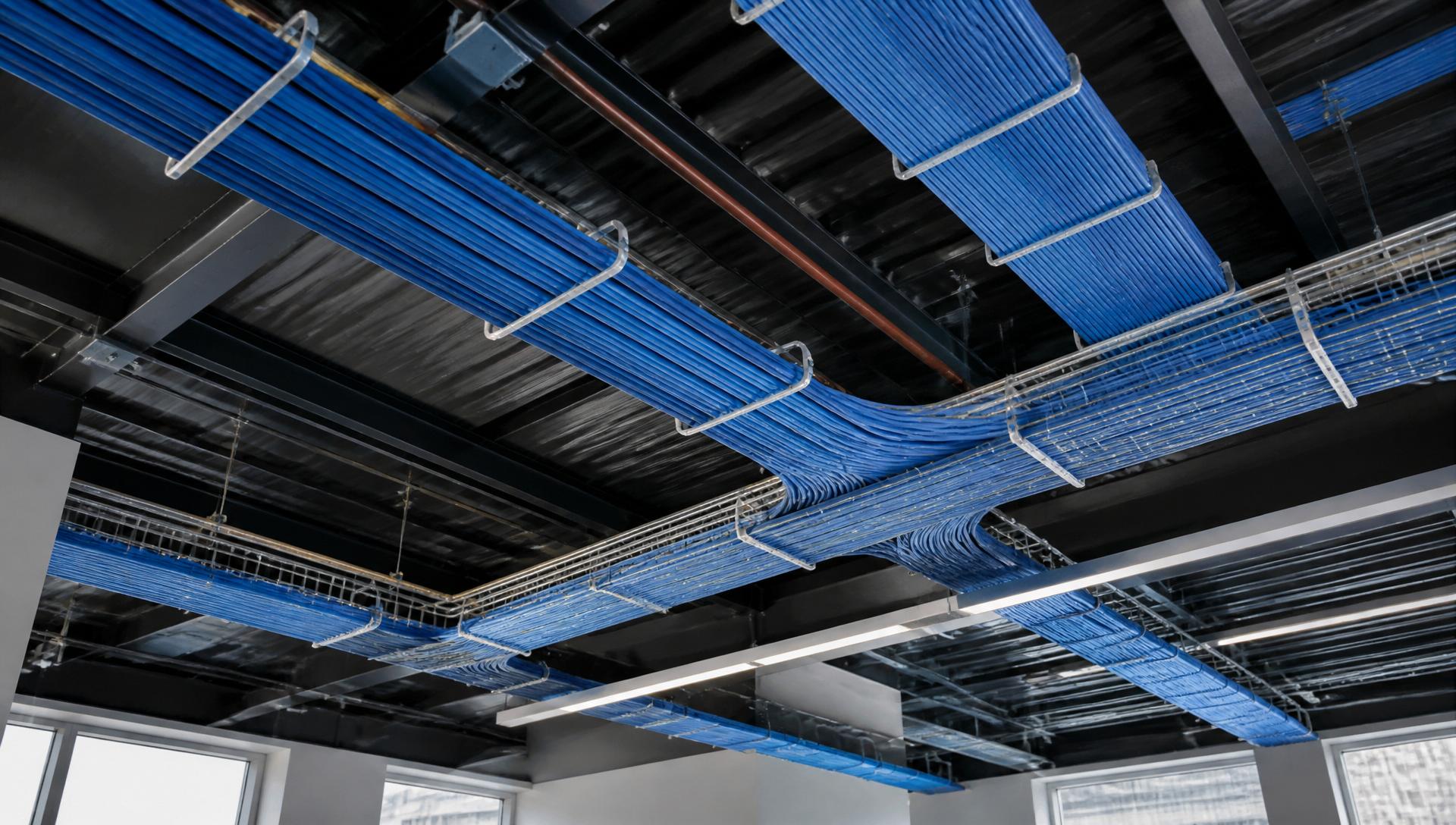
Corporate office cabling transcends simple connectivity; it encompasses a fully engineered structured cabling system designed to TIA-568 series standards, ensuring interoperability, performance, and future-proofing. This includes horizontal cabling, typically unshielded twisted pair (UTP) Category 6A or shielded (ScTP/F/UTP) for high-EMI environments, distributed from telecommunications rooms (TRs) to individual work area outlets. Optical fiber backbones, commonly multi-mode (OM3/OM4/OM5) for inter-TR links and single-mode (OS2) for campus distribution or provider demarcation, are engineered to support 10 Gigabit, 40 Gigabit, and 100 Gigabit Ethernet requirements, specified by IEEE 802.3 standards. Our designs meticulously account for pathway and space requirements as defined in TIA-569-C, ensuring proper bend radius, fill ratios, and accessible maintenance points within ceiling plenums, conduits, and cable trays.
MEP Coordination and Building Infrastructure Integration
Effective corporate office cabling requires intensive coordination with Mechanical, Electrical, and Plumbing (MEP) trades, as well as architects and general contractors. Our project managers engage in detailed BIM (Building Information Modeling) coordination sessions to identify potential conflicts and optimize cable pathways and telecommunications room layouts. This proactive approach minimizes costly rework and ensures adherence to National Electrical Code (NEC) articles governing low-voltage wiring, specifically NEC Article 800 for communications circuits, Article 770 for optical fiber cables, and Article 830 for network-powered broadband. We specify fire-rated cables (e.g., plenum-rated CMP or riser-rated CMR) in accordance with NFPA 70 and local fire codes, prioritizing occupant safety and building code compliance. Power distribution unit (PDU) requirements, grounding and bonding per TIA-607-C, and environmental controls within TRs are all integrated into the master project plan, ensuring a cohesive and functional infrastructure.
Strategic Pathway and Space Management for Scalability
Designing pathways and spaces for corporate office cabling is fundamental to long-term operational efficiency and scalability. We implement methodologies prescribed by TIA-569-C, focusing on maximizing usable space while maintaining accessibility. This includes specifying appropriately sized cable trays, conduit systems, and J-hooks to support current cable density and accommodate future expansion. Telecommunications rooms (TRs) and equipment rooms (ERs) are meticulously designed for optimal airflow, equipment rack density, and ergonomic access for moves, adds, and changes (MACs). We ensure adequate separation from EMI sources, proper grounding and bonding, and adherence to minimum clearances for electrical panels and HVAC ductwork, mitigating noise and maximizing system longevity. Furthermore, our designs anticipate the integration of building automation systems (BAS) and IoT devices, allocating dedicated pathways and logical network segments to support these emerging technologies within the corporate environment.
High-Performance Materials and Certified Components
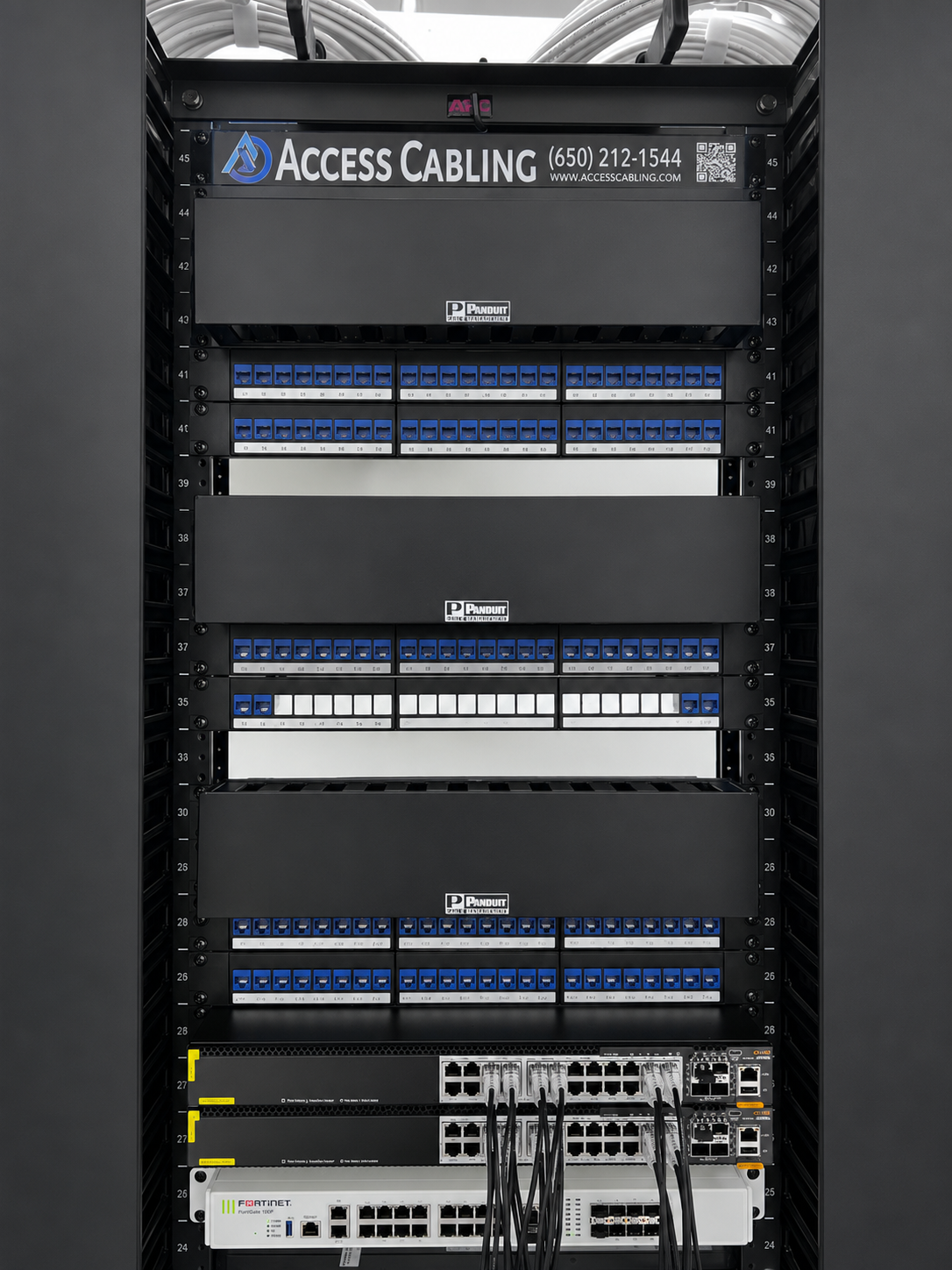
The longevity and performance of corporate network infrastructure depend heavily on the quality of installed materials. We exclusively utilize commercial-grade, TIA-compliant components from leading manufacturers such as Panduit, CommScope, Leviton, Belden, and Corning. This includes verified Category 6A UTP/F/UTP cables, OM3/OM4/OS2 fiber optic cables, high-density patch panels, modular jacks, and reliable connectivity hardware. Our specification process ensures that all components, from cable and connectors to fiber optic enclosures and patch cords, meet or exceed industry standards for insertion loss, return loss, crosstalk, and bandwidth. For example, deploying Panduit TX6A™ 10Gig™ UTP copper cabling with appropriate connectivity ensures a certified 10 Gigabit Ethernet channel, validated by Fluke Networks DSX-8000 testing. Choosing robust, enterprise-grade materials significantly reduces the total cost of ownership by eliminating premature failures and ensuring consistent network performance.
Rigorous Installation Protocols and Quality Assurance
Access Cabling’s installation process adheres to BICSI best practices and stringent internal quality assurance protocols. Our C-10/C-7 licensed technicians are trained in proper cable handling, termination techniques for both copper and fiber optic cables, and labeling conventions per TIA-606-C. For copper, this involves precise twist maintenance at termination to preserve pair integrity and minimize alien crosstalk. For fiber, it includes meticulous cleaving and polishing of connectors or fusion splicing, critical for minimizing optical signal loss. All cable runs are installed with appropriate service loops, maintaining bend radius specifications to prevent performance degradation. Every termination is visually inspected, and progressive testing is performed throughout the project lifecycle to identify and rectify issues early, ensuring the installed infrastructure meets all performance and compliance criteria prior to final certification.
Advanced Testing, Certification, and Documentation
Upon completion of every corporate office cabling installation, Access Cabling performs comprehensive testing and certification using industry-leading equipment, primarily Fluke Networks DSX-8000 CableAnalyzers. For copper cabling, this includes certifying every permanent link and channel to TIA-568.2-D Category 6A standards, verifying parameters such as Near-End Crosstalk (NEXT), Far-End Crosstalk (FEXT), Insertion Loss, Return Loss, Propagation Delay, Skew, and Alien Crosstalk (AXT) for 10 Gigabit applications. For fiber optic cabling, we perform Tier 1 testing with an Optical Loss Test Set (OLTS) for link loss and length, and optionally Tier 2 testing with an Optical Time Domain Reflectometer (OTDR) for detailed event analysis per TIA-568.3-E. Each certified link receives a Pass/Fail result and detailed test reports are provided as part of a comprehensive documentation package, which also includes as-built drawings, schematic diagrams, and labeling schedules, ensuring complete transparency and simplified future troubleshooting or modifications.
Compliance, Safety, and Long-Term Reliability
Ensuring regulatory compliance and safety is paramount in corporate office cabling projects. Our installations strictly adhere to NEC Articles 800, 770, and 830, ensuring proper cable types, grounding, and firestop requirements are met. We also incorporate BICSI TIA-606-C administration standards for labeling, making the infrastructure intuitively manageable. All work is performed by licensed C-10 and C-7 low-voltage technicians, guaranteeing adherence to California contractor licensing laws and industry best practices. Furthermore, our commitment to quality extends to environmental considerations, including proper disposal of old cabling WASTE and minimizing construction impact. This rigorous approach to compliance and safety not only protects the occupants and assets within the corporate office but also ensures the long-term reliability and manageability of the network infrastructure, minimizing operational disruptions and maximizing the investment lifecycle.
Access Cabling: Your Strategic Partner for Enterprise Infrastructure
Choosing Access Cabling as your corporate office cabling provider means partnering with a C-10/C-7 licensed contractor (CSLB 992009) with 28+ years of experience dedicated to enterprise-grade solutions. Unlike generalist installers, our specialization in complex low-voltage systems for large organizations ensures a deep understanding of corporate IT and facility requirements. We provide a single point of contact for project management, streamlined communication, and consistent quality across multi-site deployments or extensive campus environments. Our expertise in navigating challenging infrastructure constraints, integrating with existing systems, and delivering verifiable performance differentiates us. We pride ourselves on transparent communication, delivering projects on time and within budget, backed by comprehensive warranties and a commitment to post-installation support that guarantees the sustained reliability of your critical corporate network infrastructure.
Advanced OSP and ISP Fiber Optic Network Deployment
For multi-building corporate campuses or large single-site facilities, the integration of Outside Plant (OSP) and Inside Plant (ISP) fiber optic networks is paramount for high-bandwidth interconnectivity and future-proofed operations. Our approach to OSP fiber deployment encompasses direct-buried, ducted, aerial, and trenched installations, meticulously conforming to Telcordia GR-20 CORE and GR-771 CORE standards for environmental resilience and longevity. We specify and deploy ITU-T G.652.D single-mode fiber for long-haul backbone runs exceeding 300 meters, ensuring minimal attenuation and dispersion, while G.651.1 OM4/OM5 multimode fiber is utilized for inter-building links requiring 10GbE or higher speeds over shorter distances, leveraging VCSEL optimized performance. This includes careful consideration of maximum permissible bend radii, typically 10x the cable diameter for installation and 20x for long-term deployment, to prevent micro-bend and macro-bend losses. Specialized trenching equipment like Ditch Witch RT series or Vermeer RTX series, coupled with hydrovac excavation, minimizes ground disturbance and mitigates risks to existing utilities, a critical aspect of urban or developed campus environments. All OSP splices are fusion-spliced using Fujikura or Sumitomo precision fusion splicers, achieving insertion losses typically less than 0.05dB, followed by comprehensive OTDR testing (e.g., Fluke OptiFiber Pro, EXFO FTB-700 Series) from both ends to verify link integrity, document events, and confirm total attenuation budgets. Within the ISP domain, fiber backbone distribution employs riser-rated (OFNR) or plenum-rated (OFNP) cables, depending on building fire codes, routed through dedicated cable trays, conduits, and pathways that strictly adhere to NFPA 70 (NEC) and TIA-569-C pathway standards. We implement MPO/MTP pre-terminated fiber solutions for data center inter-rack or zone distribution, significantly reducing field termination time and improving consistency, delivering ultra-low loss connectivity crucial for 40/100GbE and beyond. Each fiber termination and splice is meticulously cleaned with isopropyl alcohol and inspected with a fiber microscope (e.g., Viavi P5000i) to ensure end-face quality compliant with IEC 61300-3-35 standards, preventing contamination-induced degradation, a common root cause of network performance issues in high-speed optical systems.
Integrated Security and AV Over IP Infrastructure
Modern corporate offices demand robust, converged infrastructure to support advanced security systems and Audio/Visual (AV) over IP deployments, minimizing discrete cabling runs and maximizing operational efficiency. For security, our implementations prioritize Power over Ethernet (PoE/PoE+) for IP cameras (e.g., Axis, Hanwha Vision), access control readers (e.g., HID, Mercury Security), and networked sensors, leveraging IEEE 802.3at/bt standards to provide both data connectivity and power over a single Category 6A or higher cable. This reduces conduit fill, power outlet requirements, and simplifies device placement. The physical security network is logically segregated using VLAN segmentation (e.g., Cisco Catalyst 9000 series switches with 802.1Q tagging) to isolate traffic, enhance cybersecurity posture, and ensure guaranteed bandwidth for critical surveillance feeds. Cable pathways for security devices are designed to minimize single points of failure and are often routed independently or redundantly to their respective aggregation points, adhering to specific physical security standards such as CPTED (Crime Prevention Through Environmental Design) principles. For AV over IP, we deploy systems based on AVB (Audio Video Bridging - IEEE 802.1BA/1AS/1Qav) or Dante®/AES67/SDVoE standards, typically requiring gigabit or 10-gigabit Ethernet infrastructure for uncompressed or lightly compressed video delivery. This involves careful consideration of network latency, jitter, and bandwidth prioritization using Quality of Service (QoS) mechanisms (e.g., DiffServ, MPLS Traffic Engineering) on enterprise-grade switches. The cabling infrastructure, primarily Category 6A F/UTP or S/FTP for increased EMI immunity in AV-rich environments, is designed to support long-distance UHD video transmission from sources such as Barco ClickShare or Crestron DM NVX units, distributed to displays via dedicated encoder/decoder pairs. All cabling pathways and equipment installations comply with both TIA/EIA standards for structured cabling and relevant AVIXA standards for AV infrastructure, ensuring optimal signal integrity, minimizing electromagnetic interference, and providing a scalable foundation for future technology refresh cycles. We implement strategic grounding and bonding protocols per TIA-607-C to mitigate ground loops and transient voltage issues that can plague sensitive AV equipment and compromise data integrity in security systems.
Sustainability-Driven Cabling Lifecycle Management
Integrating sustainability into corporate office cabling projects extends beyond initial installation to encompass the entire lifecycle, from material sourcing and energy efficiency to recycling and end-of-life disposal. Our approach prioritizes materials with recognized environmental certifications and recycled content where feasible, without compromising performance or safety standards. We actively promote the use of low-smoke zero-halogen (LSZH) cables for indoor applications, minimizing the emission of toxic fumes in fire events and reducing environmental impact during manufacturing and disposal compared to PVC alternatives. Our designs incorporate highly efficient Power over Ethernet (PoE, PoE+) for device powering, reducing the need for separate electrical circuits and associated material usage, contributing to a lower carbon footprint for the building's electrical infrastructure while simultaneously cutting operational energy consumption for powered devices. During installation, we implement waste reduction strategies, including meticulous cable length planning to minimize offcuts and active segregation of copper, aluminum, and plastic waste for proper recycling channels. For legacy infrastructure removal, we provide comprehensive decommissioning services, ensuring that obsolete cabling and equipment are responsibly recycled or disposed of in compliance with local environmental regulations (e.g., WEEE directives in relevant regions). This includes partnering with certified e-waste recyclers who adhere to R2 (Responsible Recycling) or e-Stewards standards, preventing hazardous materials from entering landfills. Energy efficiency is also embedded in our design principles for network components, specifying energy-efficient switches (e.g., IEEE 802.3az Energy Efficient Ethernet compliant) and optimizing cable routing to reduce cooling requirements in telecommunications rooms. We facilitate the creation of detailed asset inventories and geographic information system (GIS) mapping of cabling pathways, which not only aids in ongoing maintenance and troubleshooting but also simplifies future upgrades and minimizes wasteful 'rip and replace' scenarios by enabling targeted infrastructure enhancements rather than wholesale overhauls, thereby extending the useful life of existing infrastructure and reducing resource consumption.
Regulatory Compliance and Code Adherence Assurance
Strict adherence to a complex web of regulatory codes and industry standards is non-negotiable for enterprise cabling infrastructure. Our project execution is rigorously governed by the latest editions of relevant codes, primarily NFPA 70 (National Electrical Code - NEC) for electrical safety regarding low-voltage cabling, pathway fill rates, and grounding/bonding requirements (e.g., Article 800 Communication Circuits), and NFPA 72 for fire alarm cabling integration. For building construction and fire safety, we comply with local amendments to the International Building Code (IBC) and International Fire Code (IFC), specifically concerning firestopping penetration and plenum space classifications. All cable installations are selected based on their fire-resistance ratings (e.g., CMP, CMR, CMG, CMX) as mandated by the jurisdiction and specific building zones (e.g., plenum spaces requiring CMP for smoke and flame spread reduction). Accessibility standards, such as ADA (Americans with Disabilities Act) guidelines, are considered in the placement of telecommunications outlets and equipment for user convenience. Environmentally, our waste disposal and material handling rigorously comply with EPA regulations and state-specific hazardous waste guidelines. For data privacy and security, although not directly cabling standards, our physical security protocols and demarcation point implementations support compliance frameworks like HIPAA (for healthcare-related enterprises) or GDPR/CCPA (for data privacy) by securing access to network infrastructure and ensuring data integrity at the physical layer. Beyond mandatory codes, we build to best-practice industry standards from organizations such as TIA (Telecommunications Industry Association), including TIA-568.x (Commercial Building Telecommunications Cabling Standard), TIA-569-C (Telecommunications Pathways and Spaces), and TIA-606-C (Administration Standard for Telecommunications Infrastructure), ensuring structured documentation, proper labeling, and maintainability. Compliance extends to specific installation practices, such as maintaining proper separation distances between power and data cables (e.g., 2 inches for unshielded cables parallel to unshielded power, 12 inches when crossing without non-metallic raceways) to prevent EMI, and ensuring proper support for cable bundles to prevent damage and maintain pathway integrity (e.g., J-hooks, cable trays spaced appropriately). Each project culminates in a comprehensive Code Compliance Report, detailing material certifications, pathway conformity, testing results against TIA/ISO performance categories, and photographic evidence for critical installations, serving as a verifiable audit trail for regulatory bodies and internal stakeholders.