Expanding a franchise operation necessitates a highly coordinated, standardized approach to infrastructure deployment. Access Cabling specializes in large-scale, multi-site franchise rollouts, providing a single point of responsibility for consistent, high-performance low-voltage systems across all new or renovated locations. Our expertise ensures each franchise adheres precisely to brand-mandated communications infrastructure guidelines, from structured cabling and Wi-Fi deployments to POS system integration and security camera installations. We understand the critical need for uniformity, operational efficiency, and rapid deployment schedules inherent in a franchise model. Leveraging 28+ years of experience and a nationwide network of qualified technicians, we offer a scalable, repeatable solution that mitigates common risks associated with distributed installations, guaranteeing predictable results and seamless integration into your existing IT ecosystem. Our adherence to TIA/EIA, BICSI, and NEC standards, coupled with deep experience in franchise-specific technology stack integration, differentiates our service, delivering reliable infrastructure without compromise.
Standardized Blueprint Development & Adherence
Successful franchise rollouts hinge on an inviolable blueprint for low-voltage infrastructure. Access Cabling collaborates extensively with corporate IT and facilities teams to develop or adapt a master documentation package that specifies every component, pathway, and installation methodology. This includes detailed floor plans, conduit runs per NEC Article 800, equipment rack elevations, and exact cable routing. We leverage Computer-Aided Design (CAD) and Building Information Modeling (BIM) tools to pre-plan every aspect, ensuring consistency across diverse site dimensions while maintaining the core design intent. Our technicians are meticulously trained on these brand-specific playbooks, emphasizing adherence to component manufacturer specifications (e.g., Panduit, CommScope, Leviton, Belden performance parameters) and TIA-568 series standards for structured cabling. Deviation from the established blueprint is strictly controlled, guaranteeing that every franchise location achieves identical performance characteristics and supports the corporate technology stack without custom field modifications that could introduce future maintenance or compatibility issues.
Scalable Project Management and Logistics
Managing simultaneous deployments across multiple geographical locations is a logistical challenge demanding advanced project management. Access Cabling employs a centralized project management office (PMO) responsible for coordinating all aspects of the franchise rollout, from initial site surveys to final commissioning. This includes multi-site scheduling, procurement and staged delivery of identical materials packages (e.g., consolidated ordering of Corning fiber or Fluke Networks test equipment), and nationwide technician dispatch. Our proprietary project tracking systems provide real-time updates on each site's progress, allowing corporate stakeholders to monitor deployment status, identify potential delays proactively, and ensure consistency in execution. This scalable model is designed to absorb high volumes of concurrent projects without compromising quality or schedule, a critical factor for franchise expansion goals that often involve aggressive launch timelines. Our national footprint and vetted partner network allow us to maintain consistent service levels and response times, irrespective of location.
Technology Stack Integration and Optimization
Franchise operations rely on a specific technology stack, encompassing Point-of-Sale (POS) systems, guest Wi-Fi, back-office networks, digital signage, security surveillance (CCTV/IP cameras), and VoIP telephony. Access Cabling's design and installation methodologies are tailored to optimize the performance and integration of these diverse systems. We design structured cabling solutions (e.g., Cat6A for 10 Gigabit Ethernet to POS stations, OS2 singlemode fiber for inter-cabinet backbone links) that exceed manufacturer warranties and support bandwidth requirements for current and future applications. Wireless access point (WAP) placement, often crucial for guest experience and operational efficiency, is determined through Predictive Wi-Fi surveys utilizing tools like Ekahau or iBwave, ensuring optimal coverage and capacity. Our installations prioritize pathway separation for power and data per NEC guidelines, minimizing EMI/RFI interference, and ensuring clean power delivery to sensitive network equipment, preventing common issues that plague integrated technology systems.
Quality Assurance, Testing, and Certification
Uniformity in performance is non-negotiable for franchise networks. Access Cabling's QA process for franchise rollouts is rigorous and standardized across all sites. Following installation, every copper and fiber optic link is meticulously tested and certified using industry-leading equipment such as Fluke DSX CableAnalyzers and OptiFiber Pro units. Copper links are tested for TIA Category 5e, 6, or 6A compliance, verifying parameters like Near-End Crosstalk (NEXT), Return Loss, and Insertion Loss. Fiber links are tested for attenuation, length, and polarity per TIA-568.3-E standards, with Optical Loss Test Set (OLTS) and Optical Time Domain Reflectometer (OTDR) traces provided for critical backbone links. All test results are compiled into a comprehensive certification package, stored digitally, and accessible to the client. This verifiable documentation provides absolute assurance that each installed cable channel meets or exceeds performance specifications, ensuring full warranty qualification from manufacturers like CommScope or Belden, and validating the infrastructure's readiness for operational traffic.
Physical Security and Equipment Housing
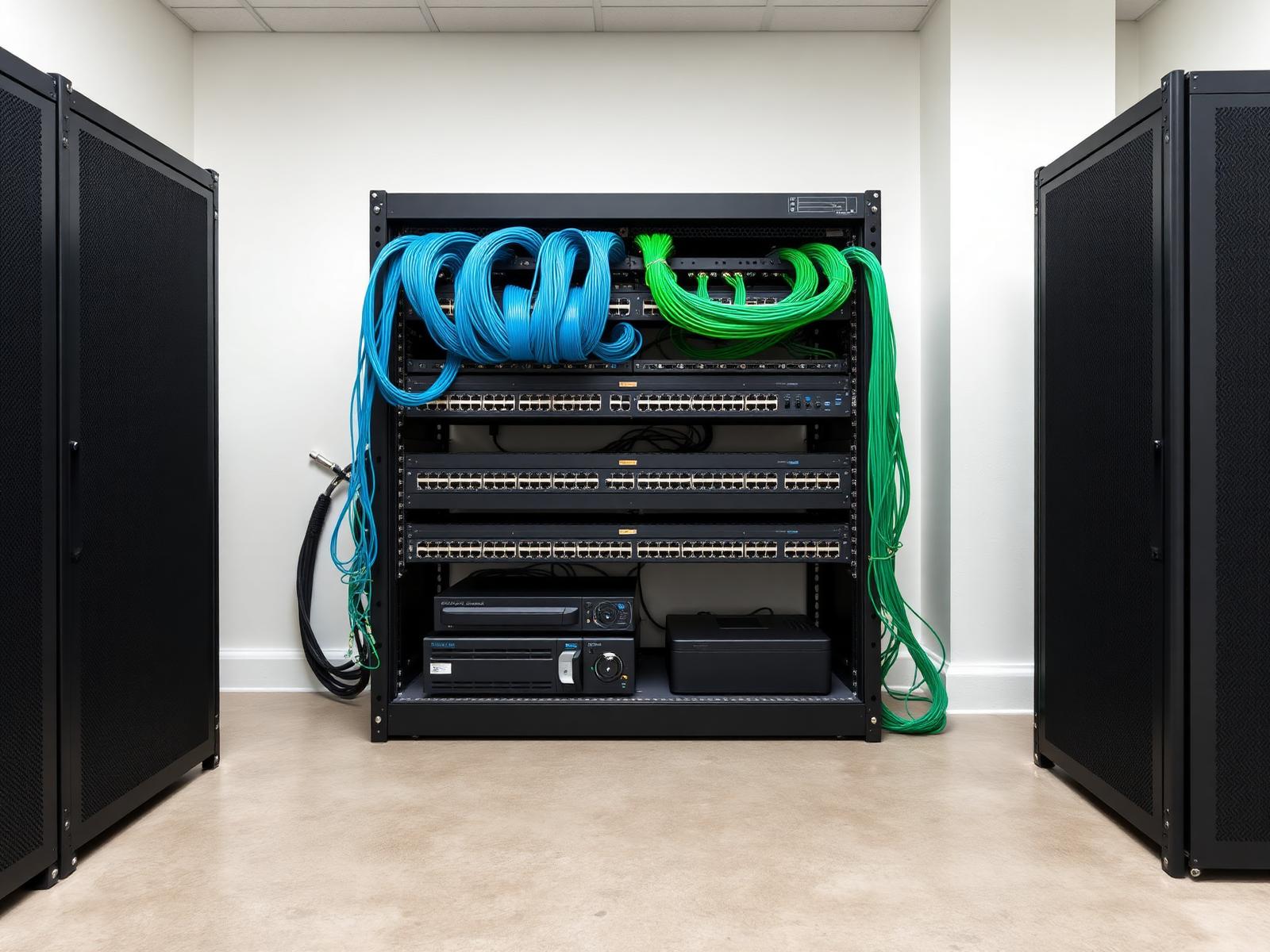
The physical security and proper housing of network infrastructure are paramount for franchise business continuity. Access Cabling designs and installs secure equipment racks and cabinets conforming to BICSI best practices and relevant TIA-942 Telecommunications Infrastructure Standard for Data Centers guidelines, even for smaller server rooms. This includes proper grounding and bonding per NEC Article 250, environmental controls (cooling and airflow management), and physical access restrictions. For distributed points of presence within a franchise location, we deploy wall-mount enclosures or secure kiosks, ensuring that active network gear and termination points are protected from unauthorized access or environmental damage. Our solutions prioritize maintainability while adhering to corporate security policies, preventing common issues like exposed cabling or unsecured switches that can lead to network downtime, data breaches, or compliance violations.
Compliance, Code Adherence, and Permitting
Navigating varying state and municipal codes is a significant hurdle in multi-location deployments. Access Cabling operates under CSLB 992009 (C-10/C-7) licensure, ensuring all work complies with the National Electrical Code (NEC) for low-voltage systems (NEC Chapters 770, 800, 820). We manage the complex process of local permitting, inspections, and Certificate of Occupancy (CO) requirements, which can differ significantly from one jurisdiction to another. Our teams are well-versed in local Authority Having Jurisdiction (AHJ) requirements, including firestopping procedures, plenum vs. non-plenum cable usage (NFP 90A), and conduit fill ratios. By proactively addressing code compliance and permitting from the planning phase, we minimize costly delays, avoid rework, and ensure that every franchise location is not only operational but also fully compliant with all governing regulations, reducing legal and operational risks for the franchisor and franchisee alike.
Post-Installation Support and Documentation Handover
The successful completion of a franchise rollout extends beyond installation. Access Cabling provides comprehensive post-installation support and detailed documentation handover for each site. This includes as-built drawings depicting actual cable runs, outlet locations, and equipment placements. We provide detailed labeling schemes (e.g., TIA-606-C compliant) for all patch panels, outlets, and cables, facilitating future troubleshooting and maintenance. A complete bill of materials (BOM), warranty information for all installed components (e.g., 25-year manufacturer warranties from Belden or Corning), and a consolidated Fluke DSX certification report are provided. This detailed documentation suite empowers the franchisee and corporate IT to effectively manage, maintain, and upgrade their network infrastructure long after the initial deployment, reducing reliance on third-party support and optimizing the long-term return on investment in their physical layer infrastructure.
Multi-Site Network Architecture Design and Implementation
Successful franchise rollouts hinge on a robust, standardized network architecture that accommodates diverse site layouts while maintaining consistency. Our approach begins with a comprehensive analysis of the franchisor's operational requirements, identifying critical applications, data flow dependencies, and projected bandwidth needs for each franchise location. This informs the design of a resilient, scalable network backbone, often leveraging technologies such as SD-WAN for optimized traffic routing, centralized management, and enhanced security across geographically dispersed sites. We meticulously specify active and passive network components, including enterprise-grade switches (e.g., Cisco Catalyst series, Aruba CX), Wi-Fi 6/6E access points (e.g., Meraki MR, Ruckus R-series) for pervasive wireless coverage, and firewalls (e.g., Palo Alto Networks, Fortinet) configured for segment isolation and threat prevention. Cabling infrastructure, typically Category 6A or fiber optic for higher bandwidth and future-proofing, is designed to TIA/EIA-568 standards, ensuring optimal performance and compliance. We also consider redundancies for critical services, such as dual-WAN links and redundant power supplies, to minimize downtime and business disruption. Our designs account for environmental conditions specific to each franchise location, from retail storefronts to light industrial units, employing appropriate conduit pathways, raceways, and enclosures to protect cabling and active equipment while adhering to local aesthetic requirements and building codes. This detailed architectural blueprint serves as the foundation for procurement, staging, and phased deployment, ensuring each franchise benefits from a high-performance, secure, and easily manageable network environment.
Streamlined Logistics and Supply Chain Optimization
Managing the logistics and supply chain for large-scale franchise rollouts presents unique challenges, primarily due to the volume of specialized equipment, the geographic dispersion of sites, and tight deployment schedules. Access Cabling employs a meticulously planned, centralized logistics model to overcome these hurdles. We establish a dedicated staging facility where all network hardware, cabling components, and ancillary equipment are meticulously kitted, configured, and tested prior to shipment. This 'staging and kitting' process significantly reduces on-site installation time and minimizes troubleshooting, as pre-configured devices are essentially 'plug-and-play' upon arrival. Our supply chain leverages strong relationships with leading manufacturers and distributors, ensuring preferential access to inventory and negotiated pricing, safeguarding against supply chain disruptions common in high-volume deployments. We utilize advanced inventory management systems to track every component, from patch panels to power supplies, ensuring accurate allocation per site and preventing costly delays associated with missing or incorrect parts. Furthermore, our logistics strategy includes optimized freight forwarding, often involving consolidated shipments to regional distribution hubs, followed by just-in-time delivery to individual franchise locations. This minimizes storage requirements at construction sites and reduces the risk of damage or theft. We also handle reverse logistics for any defective or surplus equipment, streamlining the entire lifecycle from procurement to deployment and beyond. This comprehensive logistical oversight is critical to maintaining project timelines, controlling costs, and ensuring that each franchise receives the precise, validated equipment it needs, exactly when it needs it.
Coordination with Multi-Trade Contractors and Site Managers
Effective collaboration with general contractors, electrical contractors (MEP), and individual site managers is paramount for the seamless integration of network and cabling infrastructure within new franchise builds or remodels. Our project managers initiate engagement early in the pre-construction phase, participating in regular OAC (Owner, Architect, Contractor) meetings to review architectural drawings and identify potential conflicts or opportunities for optimized pathways. This proactive approach ensures that conduit runs, electrical outlets for network equipment, and dedicated IDF/MDF closet spaces are allocated and properly sized according to our specified designs, preventing costly rework during later stages. We provide detailed CAD drawings and BIM models of our infrastructure, facilitating coordination of overhead and in-wall pathways with other trades, such as HVAC ducting, plumbing, and fire suppression systems. Our teams adhere strictly to site-specific safety protocols, often participating in site-specific safety orientations and tool-box talks. We maintain open lines of communication through designated site leads who serve as direct points of contact, providing daily progress reports and facilitating immediate resolution of unforeseen site conditions or scheduling conflicts with other trades. Furthermore, we develop clear cut-over strategies in conjunction with the franchisor and general contractor, particularly when migrating from existing legacy systems, ensuring minimal disruption to business operations during the transition phase. This multidisciplinary coordination ensures that our infrastructure is installed efficiently, adheres to all local building codes and industry standards, and is fully integrated with the broader construction timeline, avoiding schedule slippage caused by inter-trade conflicts.
Operational Sustainability and Total Cost of Ownership (TCO) Optimization
Beyond initial deployment, Access Cabling focuses on designing and implementing infrastructure that contributes to the long-term operational sustainability and optimized Total Cost of Ownership (TCO) for the franchisor. Our solutions prioritize energy efficiency through the selection of PoE+ or PoE++ enabled switches that power IP devices (e.g., cameras, access points, VoIP phones) directly over Ethernet cables, reducing the need for additional electrical runs and power adapters, thereby lowering energy consumption and heat dissipation. We standardize on modular, scalable hardware platforms that allow for incremental upgrades and easy expansion with minimal equipment replacement, extending the lifecycle of network investments. Cabling pathways are meticulously designed with future growth in mind, incorporating excess capacity and clear labeling (e.g., TIA/EIA-606-B standards) to simplify future MACs (Moves, Adds, Changes) and reduce maintenance costs. Furthermore, we champion the use of robust and certified components that meet or exceed industry standards, thereby reducing failure rates and associated truck rolls for repairs. Our documentation handover includes comprehensive as-built drawings, logical network diagrams, and detailed asset inventories, which empower internal IT teams or third-party support providers to efficiently troubleshoot and manage the infrastructure. By integrating considerations for energy efficiency, modularity, ease of maintenance, and comprehensive documentation into our rollout strategy, we enable franchisors to achieve a significantly lower TCO over the operational lifespan of their network infrastructure, maximizing their return on investment and supporting sustainable growth.