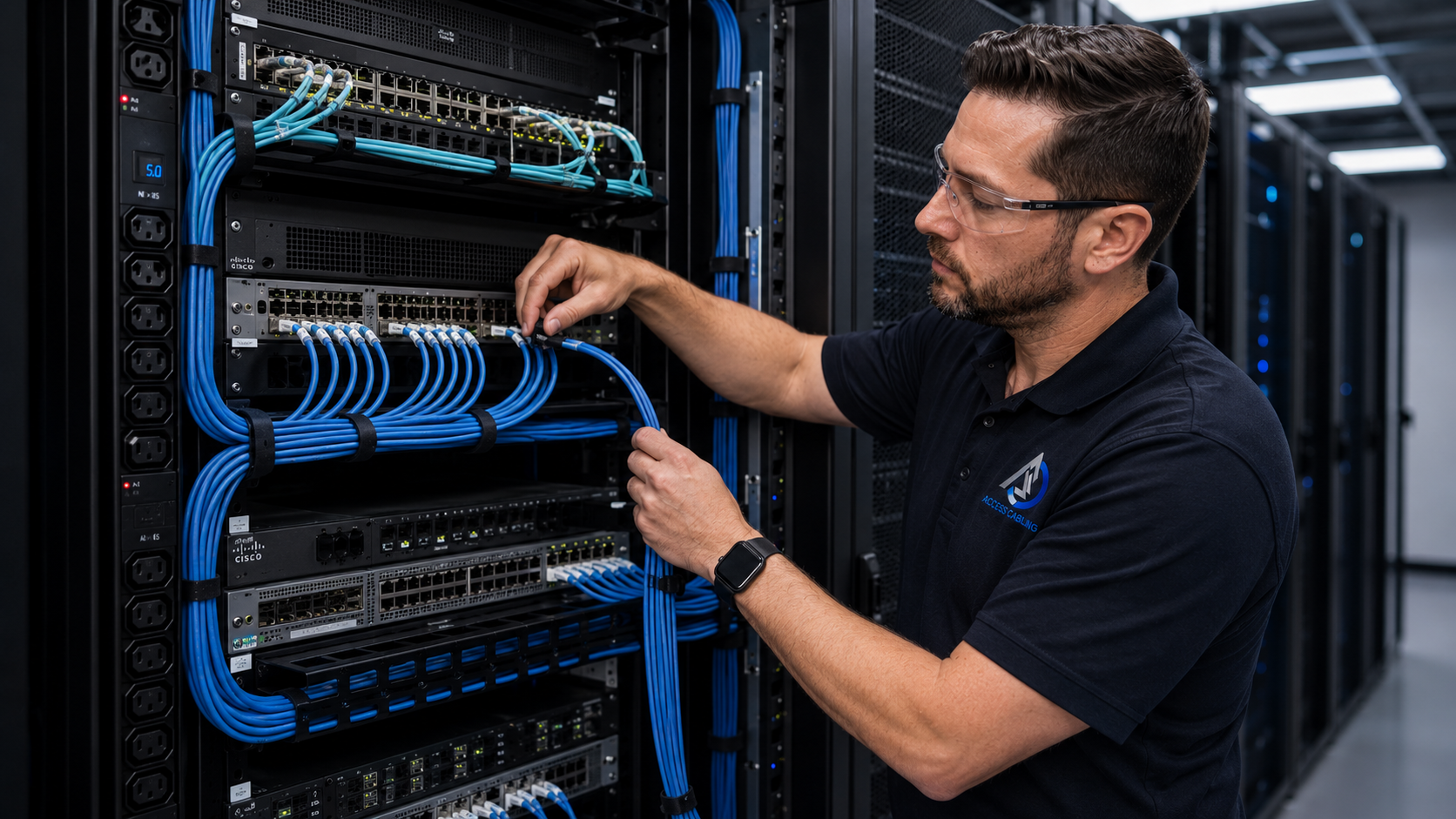
Developing and deploying hyperscale data center infrastructure demands a cabling strategy engineered for unprecedented density, bandwidth, and rapid scalability. Access Cabling provides end-to-end hyperscale data center cabling solutions, from conceptual design through implementation and certification, specifically tailored for operators managing massive compute and storage footprints. Our expertise encompasses sophisticated spine-leaf architectures, multi-mode fiber (MMF) and single-mode fiber (SMF) cross-connects, and intricate copper patching fields within meet-me rooms (MMRs) and colocation facilities. As a licensed C-10/C-7 contractor with 28+ years of dedicated experience, we understand the critical interplay between granular PUE optimization, high-speed data transfer, and the physical layer integrity essential for 200GbE, 400GbE, and emerging 800GbE deployments. We differentiate ourselves through rigorous adherence to TIA-942-B and ANSI/BICSI 002-202X standards, meticulous documentation practices, and a proactive project management methodology that minimizes disruption and accelerates time-to-market for your hyperscale deployments.
Hyperscale Cabling Architecture: Spine-Leaf Topologies and Standards
Hyperscale data centers fundamentally deviate from traditional three-tier architectures, primarily employing spine-leaf topologies to ensure low-latency, high-bandwidth interconnectivity between vast numbers of servers. This architecture, often necessitating 100% server-to-server connectivity, drives the requirement for highly structured and scalable cabling. Our designs strictly adhere to TIA-942-B (Telecommunications Infrastructure Standard for Data Centers) and ANSI/BICSI 002-202X (Data Center Design and Implementation Best Practices), which dictate physical infrastructure performance, pathways, spaces, and environmental conditions. We implement fiber optic cabling, predominantly OM4/OM5 multi-mode and OS2 single-mode, to support the high-density MPO/MTP trunking from top-of-rack (ToR) switches to leaf switches, and further up to the spine layer. Optical Distribution Frames (ODFs) and Fiber Distribution Panels (FDPs) are strategically deployed to manage breakout and cross-connect requirements, ensuring minimal optical loss budgets crucial for 400GbE and future 800GbE links over extended distances. Our approach optimizes cable pathways within raised floors or overhead containment systems to maintain TIA-569-D compliance while preserving critical airflow dynamics and fire suppression system efficacy, directly impacting data center PUE and operational expenditure.
Design & Engineering for Massive Scale and Future-Proofing
The engineering phase for hyperscale cabling solutions must anticipate exponential growth and evolving networking standards. Our design process initiates with a comprehensive analysis of the client's current and projected compute, storage, and networking demands, integrating directly with their network architecture plans. We focus on modularity and scalability, designing backbone and horizontale distributions to accommodate future port density increases without requiring a complete overhaul. This involves meticulous planning of main distribution areas (MDAs), intermediate distribution areas (IDAs), and zone distribution areas (ZDAs), optimizing cable lengths and pathways to reduce clutter and simplify MACs (Moves, Adds, Changes). We utilize advanced CAD/BIM software for detailed pathway planning, clash detection, and accurate bill of materials generation, ensuring adherence to strict budget and timeline constraints. Fiber optic cable selection, whether bend-insensitive single-mode for long-haul inter-building links or high-speed multi-mode for intra-building server connections, is based on the application's specific reach, loss budget, and future upgrade path, preventing costly re-cabling as speeds transition from 100GbE to 400GbE and beyond. Our designs often incorporate manufacturer-specific pre-terminated solutions, such as Panduit QuickNet or CommScope InstaPATCH, for rapid deployment and guaranteed performance.
Component Selection: Performance-Critical Materials for Hyperscale
The selection of cabling components in a hyperscale environment is paramount to achieving and sustaining peak network performance. We specify and deploy only enterprise-grade cabling and connectivity from industry-leading manufacturers such as Corning, Belden, CommScope, Panduit, and Leviton. For fiber optic infrastructure, this includes OS2 single-mode fiber for long-distance backbone and inter-data center links, and OM4/OM5 multi-mode fiber for high-density, intra-data center connections supporting 100G, 200G, and 400G SR4/SR8/SR16 transceivers. Our fiber optic connectors are predominantly MPO/MTP for trunking, LC for patch connections, and SC for specific legacy or slower-speed interfaces, all rigorously cleaned and inspected to minimize insertion loss. Copper solutions, while less prevalent in core hyperscale, are still critical for out-of-band management, KVM, and specific low-latency edge applications, utilizing Category 6A or higher-rated shielded twisted pair (STP) cabling to mitigate EMI. Rack-mount fiber enclosures, cable management systems (vertical and horizontal), and advanced PDU (Power Distribution Unit) integration are meticulously chosen to optimize airflow, density, and accessibility for maintenance within high-density server racks. All components are selected not only for their current performance but also for their ability to support future network upgrades, such as migration to 800GbE or higher, without requiring wholesale infrastructure replacement.
Precision Installation & Deployment in Live Environments
Hyperscale deployments often occur in live or rapidly expanding data center environments, demanding a highly disciplined and minimally intrusive installation methodology. Our certified technicians execute installations with surgical precision, adhering to strict Method of Procedure (MOP) documentation developed in partnership with client operations teams. This includes detailed cable routing diagrams, labeling conventions compliant with TIA-606-C, and precise termination sequences for MPO/MTP connectors to ensure correct polarity and fiber mapping for SR4/SR8/SR16 deployments. Our teams are proficient in installing massive quantities of pre-terminated fiber optic assemblies, reducing on-site termination time and improving consistency. Overhead and under-floor cable tray systems (basket tray, ladder rack) are installed to maintain proper bend radii, load bearing capacity, and separation from power cabling in accordance with NEC Articles 770 and 800. We implement meticulous firestopping solutions at all pathway penetrations as per code, preventing propagation through the data center. Every cable run, patch panel, and distribution frame is precisely labeled using industrial-grade, machine-printed identifiers, facilitating rapid troubleshooting and future modifications, significantly reducing operational expenditure related to MACs.
Rigorous Testing & Certification for Performance Assurance
Certification is not merely a formality but a critical validation of the entire physical layer infrastructure's performance and integrity. For fiber optic cabling, we perform Tier 1 (basic) and Tier 2 (extended) certification using calibrated Fluke Networks DSX-8000 or equivalent OLTS/OTDR test equipment, providing comprehensive optical loss and length measurements, and identifying any faults or bends with their precise locations. Each fiber strand in every MPO/MTP trunk is tested for insertion loss against TIA/ISO standards, guaranteeing compliance with application-specific loss budgets (e.g., 100GBASE-SR4 requirements). For any copper installations, certification involves testing for alien crosstalk, return loss, insertion loss, and near-end crosstalk (NEXT) to ensure compliance with Category 6A or higher specifications. All test results are compiled into a comprehensive digital report, accessible to the client for auditing and warranty purposes. This rigorous testing process provides unequivocal proof of performance, minimizes post-deployment issues, and ensures the cabling infrastructure will reliably support current and future high-speed network protocols, thereby safeguarding the significant investment in hyperscale hardware.
Operational Security and Compliance in Critical Environments
Maintaining the highest levels of operational security and compliance is non-negotiable in hyperscale data center projects. Our teams are accustomed to working within highly controlled environments, often requiring background checks, specific badging, and adherence to client-specific physical and logical security protocols (e.g., SOC 2, HIPAA, PCI DSS). All personnel are trained on data center best practices for hot/cold aisle containment, preventing contamination from dust or debris, and working safely around live equipment, including adherence to LOTO (lockout/tagout) procedures when required. Cable routing and pathway design incorporate physical separation requirements to prevent unauthorized access or accidental disruption. Furthermore, all installations are performed in strict accordance with the National Electrical Code (NEC), NFPA 75 (Standard for the Fire Protection of Information Technology Equipment), and local building codes. This includes proper grounding and bonding of all conductive elements, fire-rated pathway penetrations, and management of cable bundles to prevent overheating or fire hazards. Our commitment to compliance extends to meticulous record-keeping and as-built documentation, crucial for regulatory audits and long-term operational integrity.
Access Cabling's Differentiator: Experience at Scale
Our distinguishing factor in the hyperscale data center market lies in our deep, proven experience managing projects of immense scale and complexity over 28 years. We are not simply installers; we are low-voltage infrastructure specialists who understand the intricate dependencies within a hyperscale ecosystem. Our ability to mobilize large, highly-trained, manufacturer-certified teams (e.g., Corning LANscape, Panduit Certified Installer, CommScope SYSTIMAX) nationwide ensures consistent quality and adherence to strict timelines across distributed data center footprints. We pride ourselves on transparent communication, proactive problem-solving, and a vendor-agnostic approach that prioritizes the best-fit technology solution for each client's unique requirements, rather than pushing a single manufacturer. Our project managers are adept at integrating with tenant and general contractor schedules, leveraging sophisticated P6 (Primavera 6) or equivalent tools for critical path management. This holistic approach, combined with our CSLB 992009 licensing and unwavering commitment to TIA/EIA, BICSI, and NEC standards, positions Access Cabling as the trusted partner for constructing the foundational physical layer of the world's most demanding hyperscale environments.
Advanced Power Distribution and Cooling Interdependencies
In hyperscale environments, the dense concentration of high-wattage computing equipment necessitates an intricately coordinated cabling infrastructure that extends beyond traditional data or fiber optic runs, directly impacting power distribution and cooling efficacy. Our engineering approach meticulously addresses the interdependencies between network cabling pathways and critical power delivery systems (e.g., busway, rack PDUs, DC power modules) and advanced cooling solutions (e.g., liquid immersion, direct-to-chip, rear-door heat exchangers). We employ computational fluid dynamics (CFD) analysis during the design phase to predict thermal envelopes and identify potential hotspots caused by cable congestion, especially within high-density rack configurations. This analysis informs cable routing strategies, specifying techniques such as vertical cable managers with integrated airflow baffles, hot/cold aisle containment adherence, and plenum-rated cabling (e.g., OFNP/CMP) to prevent air recirculation and maintain optimal cooling efficiencies in heavily trafficked zones. Furthermore, the capacity planning for power circuits must account for future cabling expansions, ensuring that the physical pathways for both data and power can scale concurrently without violating National Electrical Code (NEC) fill ratios or impeding thermal management. This foresight prevents costly retrofits or derating of infrastructure due to insufficient power drops or restricted airflow pathways, which are common pitfalls in rapidly expanding hyperscale footprints.
Scalable Cable Management and Pathway Orchestration
Effective cable management in a hyperscale scenario is not merely about aesthetics; it is a critical determinant of operational efficiency, maintainability, and future scalability. We implement highly structured cable management systems designed to accommodate thousands of high-density fiber optic and copper links per rack, leveraging innovative products such as ultra-high-density fiber cassettes, flexible patch cord management, and dedicated vertical and horizontal cable trays with segregated pathways for different media types (e.g., power vs. data, multimode vs. single-mode). Our pathway orchestration considers the entire data center's lifecycle, from initial deployment to substantial technology refreshes. This includes planning for redundant pathways, ensuring that no single point of failure in the cable infrastructure can bring down a critical cluster. We utilize sophisticated CAD/BIM software to model all cabling pathways in three dimensions, predicting fill rates, bend radius violations, and potential interference with other building systems (e.g., Sprinkler systems, HVAC ducts) before onsite deployment. This proactive approach minimizes on-site delays, streamlines maintenance operations, and ensures rapid identification and resolution of infrastructure-related issues, directly contributing to higher network uptime and reduced mean time to repair (MTTR) within a hyper-converged architecture.
Automation and Orchestration for Rapid Deployment
Deploying cabling infrastructure at hyperscale demands a level of efficiency and precision that manual processes cannot reliably deliver. We leverage automation and orchestration tools to streamline every phase of the project, from pre-terminated cabling solutions to automated testing and documentation. Our use of machine-terminated MPO/MTP trunk cables and pre-kitted fiber optic assemblies drastically reduces on-site installation time and minimizes human error, ensuring consistent performance characteristics across thousands of links. For copper cabling, we often utilize 'punchless' connectivity solutions or robotic terminators where applicable to accelerate deployment. Furthermore, our project management integrates directly with client-side automation platforms, facilitating just-in-time delivery of components and coordinating seamlessly with other trades (e.g., electrical, mechanical, and general contractors) through shared digital twins. This orchestration extends to post-installation, where automated optical time-domain reflectometer (OTDR) testing and link certification equipment with built-in reporting capabilities rapidly validate performance against IEEE 802.3 and TIA/EIA standards. This ensures that every newly installed link is immediately ready for network operationalization, significantly compressing deployment timelines and speeding up time-to-market for new compute capacity, which is paramount in hyperscale environments.
Comprehensive Documentation and Lifecycle Management
In a hyperscale environment, accurate and exhaustive documentation of the cabling infrastructure is not a luxury but an absolute necessity for efficient operations, effective troubleshooting, and future planning. Our deliverables include multi-layered documentation packages that go beyond simple wiring schematics. We provide detailed run lists specifying every fiber and copper pair, port assignments on active and passive equipment, patch panel mappings, and precise cable lengths with unique identifiers for every physical link. This is complemented by granular, as-built CAD/BIM models that reflect the exact physical routing and placement of all cabling, trays, conduits, and associated infrastructure components, ensuring consistency between the digital representation and the physical deployment. We also integrate this data into client-specific Data Center Infrastructure Management (DCIM) platforms, establishing a living database of the cabling plant that supports rapid fault isolation, capacity planning, and change management. This meticulous approach to documentation mitigates the 'tribal knowledge' risk, enables accurate asset tracking for audits and regulatory compliance (e.g., SOX, HIPAA, PCI DSS), and significantly reduces the operational costs associated with infrastructure changes, expansions, or problem resolution over the entire lifecycle of the hyperscale facility. Without this level of detail, managing the sheer volume and complexity of a hyperscale cabling footprint becomes unsustainable.