Enterprise network expansion or campus interconnectivity often necessitates robust infrastructure that is impervious to above-ground hazards. Establishing reliable fiber optic pathways through subterranean environments requires specialized engineering and installation expertise in underground fiber. Access Cabling provides comprehensive design, deployment, and documentation for both directional bore and trenched underground fiber installations, delivering high-bandwidth, resilient connectivity solutions for 데이터 centers, industrial campuses, utility grids, and telecommunication providers. Our approach integrates meticulous site assessment, adherence to stringent industry standards like NEC and TIA/EIA, and utilization of advanced boring and trenching technologies to ensure optimal performance and longevity of your critical network backbones. We prioritize infrastructure integrity and minimize operational disruption, offering a predictable path to future-proofed connectivity.
Underground Fiber: Design and Pathway Engineering
The foundational stage of any underground fiber project is comprehensive design and pathway engineering. This involves a thorough geotechnical survey to understand soil composition, rock formations, and hydrostatic conditions, which dictates the feasibility and methodology of boring or trenching. Route planning considers existing subsurface utilities (gas, water, sewer, electrical, other communications lines) to prevent conflicts, requiring detailed utility locate services (e.g., Dig Alert/811) and ground-penetrating radar (GPR) where necessary. The design specifies conduit material and size, typically HDPE (High-Density Polyethylene) for its durability, flexibility, and chemical resistance, with varying SDR (Standard Dimension Ratio) depending on expected loads and environmental factors. Conduit pathways are engineered to minimize bend radius violations for the specific fiber cables to be installed, ensuring that attenuation losses are kept within TIA/EIA-568-D limits. Our engineering team meticulously maps out entrance points, planned splice locations, and future access points, leveraging GIS data for precise documentation. This initial phase is critical for mitigating risks, optimizing material use, and guaranteeing the long-term operational integrity of the underground fiber plant.
Horizontal Directional Drilling (HDD) for Fiber
Horizontal Directional Drilling (HDD), often referred to as directional boring, is a trenchless method for installing underground fiber conduits without extensive surface excavation. This technique is favored in situations where open trenching is impractical or prohibited, such as crossing roadways, rivers, environmentally sensitive areas, or heavily landscaped properties. The process involves drilling a pilot bore along a predetermined path using a steerable drill head, which is tracked precisely from the surface. Once the pilot bore is complete, a reamer is attached to enlarge the bore hole to the required diameter. Finally, the conduit (or a bundle of conduits for future expansion) is pulled back through the enlarged bore. HDD significantly reduces environmental impact, minimizes public disruption, and often accelerates project timelines compared to traditional trenching. Success hinges on accurate subsurface utility engineering (SUE) prior to drilling, precise bore path planning, and careful management of drilling fluids (bentonite slurry) to prevent inadvertent returns or frack-outs. We deploy Fluke DSX CableAnalyzer series for post-installation validation of optical loss budget, ensuring that the critical infrastructure meets performance specifications.
Open Trenching: Methodologies and Applications
Open trenching represents a direct burial method for underground fiber deployment, primarily used in greenfield developments, industrial parks, or agricultural areas where surface disruption is less critical and access is unconstrained. This method involves excavating a trench of specified depth and width, typically adhering to NEC Article 770 for optical fiber cables, which might require a minimum cover depth of 24 to 36 inches, depending on location and voltage proximity. Fiber optic conduit, or sometimes direct-burial rated fiber cable, is then laid within the trench. For conduit installations, often a bed of sand or fine aggregate is provided to protect the conduit from sharp objects and compaction stress, followed by backfilling and compaction. Warning tape (e.g., 'CAUTION: FIBER OPTIC CABLE BURIED BELOW') is typically installed above the conduit for future identification and protection. While more disruptive initially, open trenching can be more cost-effective for extensive runs in accessible terrain. Considerations include spoil management, soil erosion control, and proper restoration of disturbed surfaces. The choice between trenching and directional boring is dictated by site-specific conditions, budget, environmental regulatory requirements, and future accessibility needs for maintenance or upgrades.
Conduit System Selection and Cable Specifications
The integrity of an underground fiber plant relies heavily on the selection of appropriate conduit and fiber optic cables. For conduit, HDPE (High-Density Polyethylene) is the predominant material due to its flexibility, durability, and resistance to environmental stressors, available in various diameters (e.g., 1.25", 1.5", 2", 4" Schedule 40 or 80) and SDR ratings (e.g., SDR 11, SDR 13.5). For critical applications, Schedule 40 or Schedule 80 PVC may be used for superior crush resistance. We often deploy innerducts (e.g., 3-way or 4-way sub-ducts within a larger conduit) to facilitate multiple fiber pulls or segregation of different cable types, allowing for future expansion without re-excavation. Fiber optic cables must be rated for outdoor, direct-burial, or duct applications, typically featuring robust outer jackets such as LLDPE (Linear Low-Density Polyethylene) and often incorporating steel or aramidic strength members for rodent protection and tensile strength during pulls. Common fiber types include OS2 single-mode for long-haul routes and data center interconnects, or OM3/OM4 multimode for shorter campus backbones. All cable selections adhere to TIA/EIA-568-D standards for optical performance and IEEE 802.3 Ethernet standards for transmission capabilities, sourced from reputable manufacturers like Corning, CommScope, and Belden.
Fiber Optic Splicing and Termination Enclosures
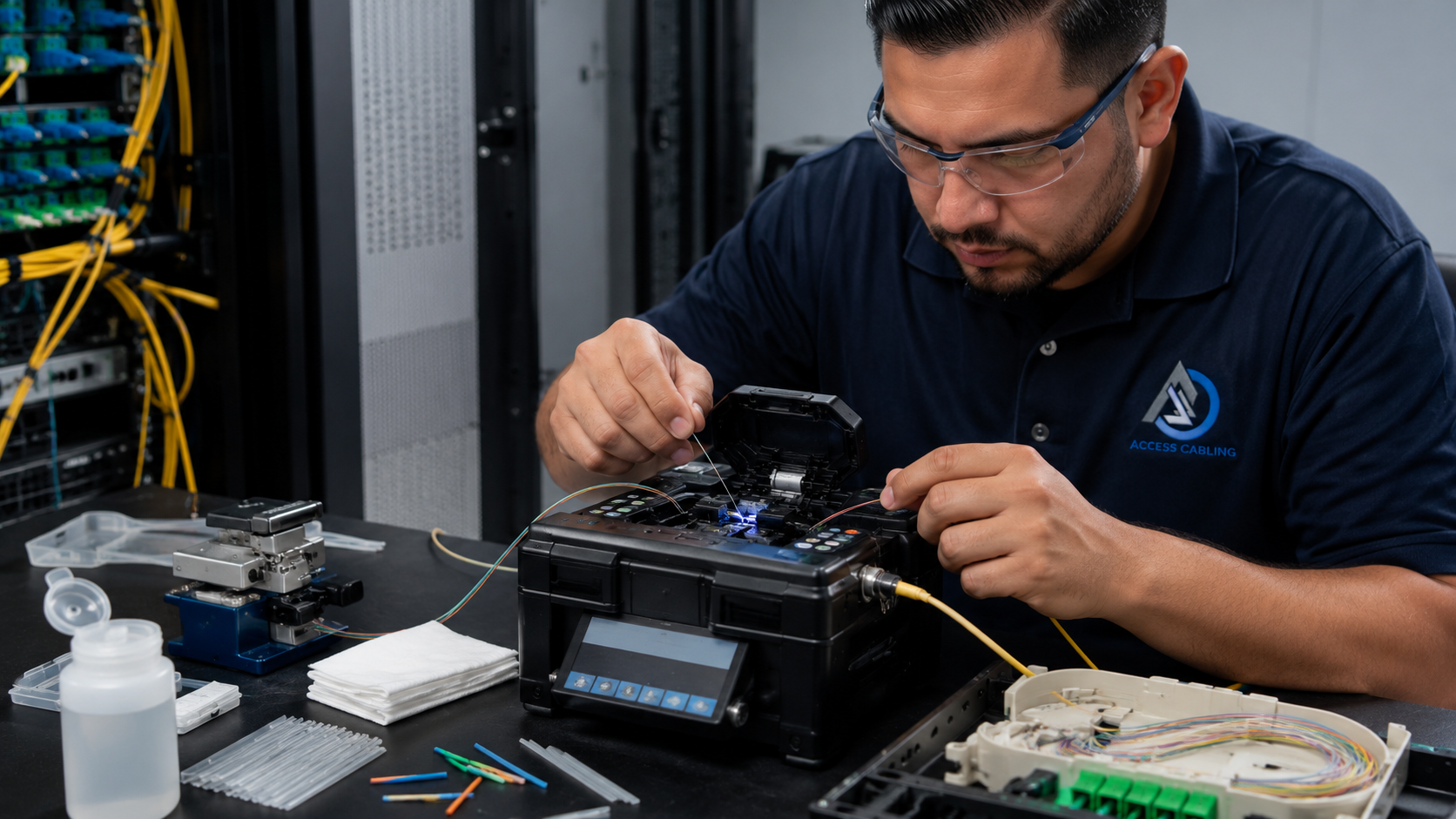
Successful underground fiber deployment culminates in precise splicing and robust termination. Fusion splicing is the preferred method for joining optical fibers in underground applications due to its low loss and high reliability, with typical splice losses below 0.05dB. Our certified technicians utilize Fujikura or Sumitomo fusion splicers, ensuring consistent, high-performance splices. Splices are meticulously organized and protected within weather-sealed, environmentally hardened fiber optic splice closures (e.g., CommScope, Corning OptiSheath, or Panduit Opti-Core closures). These closures are designed to withstand moisture, temperature extremes, and physical stress, providing secure housing for exposed fibers and splices, often rated to IP68. For termination at building entry points, weatherproof OSP (Outside Plant) rated fiber optic distribution panels or wall-mount enclosures are used. These enclosures typically house patch panels for LC or SC connectors, facilitating easy patching to internal network equipment. Proper grounding and bonding of metallic elements within the enclosure are critical, adhering to NEC Article 250 requirements for electrical safety and lightning protection. All fiber pathways are labeled meticulously at every access point and termination enclosure, conforming to TIA/EIA-606-C administration standards for future maintenance and troubleshooting.
Testing, Certification, and Documentation
Post-installation validation is paramount for underground fiber infrastructure. Access Cabling performs comprehensive testing and certification to guarantee performance and compliance. Our technicians utilize Fluke Networks OptiFiber Pro OTDRs (Optical Time Domain Reflectometer) for baseline measurements, identifying fiber lengths, attenuation, and splice/connector losses. Link loss testing, conducted with Fluke DSX CableAnalyzer series or specialized optical loss test sets (OLTS), verifies end-to-end attenuation according to TIA/EIA-568-D standards and the calculated optical loss budget. Bi-directional testing ensures accuracy in loss measurements for all channels. For single-mode fiber, ORL (Optical Return Loss) testing is also performed to assess connector and splice quality. All test results are compiled into detailed certification reports, providing a 'birth certificate' for the fiber plant. Furthermore, comprehensive 'as-built' documentation is provided, including GIS maps of the fiber routes, splice diagrams, conduit layouts, and termination schematics, essential for asset management, future expansion, and efficient troubleshooting. This rigorous documentation ensures the client possesses a complete and accurate record of their underground fiber investment.
Compliance, Safety, and Permitting Expertise
Underground fiber optic installations are subject to a complex web of regulations, codes, and safety protocols. Access Cabling ensures strict adherence to all applicable standards, including but not limited to the National Electrical Code (NEC), specifically Article 770 for Optical Fiber Cables and Raceways, and Article 800 for Communications Circuits. We also comply with OSHA safety regulations for excavation, confined space entry (if applicable for vault work), and general construction safety. Before any ground-breaking activity, comprehensive permitting processes are managed, requiring coordination with local municipalities, utility companies, and environmental agencies. This includes obtaining encroachment permits for public rights-of-way, assessing environmental impact, and ensuring all dig notifications (e.g., 811 'Call Before You Dig') are rigorously followed. Our project managers are adept at navigating these regulatory landscapes, ensuring that all aspects of the underground fiber deployment comply with federal, state, and local requirements, minimizing legal risks and project delays. Safety is integrated into every phase, from initial site survey to final restoration, protecting personnel, property, and the public.
Why Choose Access Cabling for Underground Fiber
Access Cabling offers unparalleled expertise in underground fiber infrastructure, distinguished by our C-10/C-7 low-voltage contractor license (CSLB 992009) and 28+ years of experience across California and nationwide. Unlike general contractors, our specialization guarantees a deep understanding of optical fiber characteristics, installation methodologies, and industry-specific challenges. We employ BICSI-certified RCDDs (Registered Communications Distribution Designers) for robust system design and certified technicians for precision installation and testing. Our vendor-neutral approach allows us to specify and deploy optimal components from leading manufacturers such as CommScope, Corning, Panduit, and Belden, ensuring reliability and performance. We own and maintain our fleet of specialized equipment for directional boring and trenching, providing greater control over project timelines and quality. From initial site assessment and utility coordination to final testing and as-built documentation, we deliver a turnkey solution that reduces complexity and risk for IT directors, facilities managers, and general contractors seeking resilient, high-capacity underground fiber optic networks. Our commitment is to deliver flawlessly executed infrastructure that stands the test of time and accelerates your operational capabilities.
Advanced Locating and Subsurface Utility Engineering (SUE)
Before any groundbreaking commences, comprehensive subsurface utility engineering (SUE) is paramount for underground fiber optic installations. This involves a multi-tiered approach, beginning with Level D (record research) and progressing through Level C (survey and surface utility feature mapping), Level B (designating utility horizontal position using geophysical methods like ground penetrating radar (GPR), electromagnetic (EM) induction, and acoustic pipe locators), and ultimately Level A (potholing/vacuum excavation for precise vertical and horizontal location validation). The utilization of technologies such as multi-frequency GPR systems, often employing 400MHz or 900MHz antennas operating in conjunction with RTK GNSS for centimeter-level accuracy, provides critical insights into the spaghetti-like complexity of subterranean infrastructure, including existing power conduits, gas lines, water mains, and telecommunication ducts. Failure to accurately map these elements results in significant project delays due to utility strikes, increased costs for repairs and rerouting, and potential safety hazards. Our engineers meticulously overlay SUE data onto project blueprints, identifying potential conflicts and optimizing fiber pathway designs to mitigate risks, ensuring compliance with ASCE 38-02 and other relevant SUE standards. Furthermore, we evaluate soil resistivity, particularly in areas prone to telluric currents or lightning activity, as this can influence cathodic protection requirements for metallic components within the fiber infrastructure, or necessitate specific grounding methodologies to protect sensitive optical amplification equipment where applicable during long-haul runs.
Frictionless Permitting, ROW Acquisition, and Stakeholder Engagement
Executing successful underground fiber deployments requires more than just technical prowess; it demands a sophisticated understanding of regulatory landscapes, right-of-way (ROW) acquisition processes, and robust stakeholder engagement. Navigating the labyrinth of local, county, state, and federal permitting requirements – including Department of Transportation (DOT) permits, environmental impact assessments (EIAs), railroad crossing agreements, and municipal encroachment permits – is a critical path item that can significantly impact project timelines and budgets. Our dedicated team specializes in expediting these processes by leveraging pre-existing relationships with permitting authorities, meticulously preparing documentation, and adhering rigorously to jurisdictional specifics, such as setback requirements, restoration mandates, and traffic management plans (e.g., MUTCD standards for temporary traffic control). For complex or large-scale projects, this often involves detailed negotiations with private landowners for easements, explaining the long-term benefits and minimal aesthetic impact of buried infrastructure, or collaborating with existing utility pole owners for 'make-ready' work if hybrid aerial-underground approaches are considered. Proactive, transparent communication with all affected parties – from property owners to environmental agencies and local businesses – is crucial for minimizing opposition, addressing concerns promptly, and securing the necessary approvals to proceed without costly delays or injunctions. This proactive approach ensures that all legal and community considerations are meticulously managed, upholding project integrity and minimizing potential liabilities throughout the lifecycle of the installation.
Environmental Mitigation and Site Restoration Protocols
Underground fiber optic installation, while minimizing visual impact, inherently involves ground disturbance that necessitates stringent environmental mitigation and meticulous site restoration. Our methodologies adhere to or exceed local environmental regulations, including Erosion and Sediment Control (ESC) plans compliant with EPA NPDES permitting requirements. This involves the strategic deployment of silt fencing, sediment traps, stormwater pollution prevention plans (SWPPP), and dewatering filtration systems to prevent soil runoff into sensitive ecosystems or public waterways. Soil compaction, a common by-product of trenching and heavy equipment usage, is addressed through specific backfilling techniques and, where necessary, soil amendment and decompaction protocols to ensure proper drainage and support future vegetation growth. For projects traversing ecologically sensitive areas, such as wetlands, riparian zones, or protected habitats, we implement specialized techniques like bored crossings (e.g., mini-HDD to avoid surface impact) or utilize biodegradable materials where appropriate. Post-installation, comprehensive site restoration is executed, including regrading to match original contours, seeding with native grasses or vegetation, and replacing disturbed hardscapes such as asphalt, concrete, or pavers to their original condition or better. We utilize precise compaction testing (e.g., using a nuclear densometer or dynamic cone penetrometer) to ensure backfill stability and prevent future settling or depressions, which can lead to costly remediation or aesthetic degradation. This commitment to 'leave no trace' or, ideally, 'leave it better than we found it' is not only a regulatory obligation but a core tenet of our operational philosophy, ensuring long-term environmental stewardship and minimizing community impact.
Long-Term OSP Maintenance, Network Hardening, and Resilience
The longevity and reliability of underground fiber networks are not solely determined by initial installation quality but by a comprehensive long-term Outside Plant (OSP) maintenance and network hardening strategy. This encompasses routine inspections, proactive identification of potential degradation points, and a robust rapid-response repair framework. Our maintenance programs include periodic inspections for ground subsidence, erosion exposing conduit, or signs of third-party damage (e.g., due to construction activity, utility strikes, or even rodent intrusion where direct-buried cables are used in certain environments). We advocate for the deployment of durable, robust conduit systems, such as HDPE (High-Density Polyethylene) or steel conduits, suitable for anticipated future growth and potential up-gauging of fiber counts, while also considering specialized casings for river crossings or high-stress environments. Network hardening strategies involve creating redundant fiber paths (e.g., diverse routing through different rights-of-way or separate conduits), deploying armored cables (e.g., corrugated steel tape armor) in high-risk areas, and utilizing robust, sealed splice closures designed for harsh subterranean conditions (e.g., IP68 rated enclosures with gel or heat-shrink sealing technology). Furthermore, we design protocols for emergency fault location, often employing Optical Time Domain Reflectometers (OTDRs) with sophisticated mapping software to pinpoint breaks within meters, even miles away, expediting repair times. Our proactive approach includes maintaining detailed GIS-based records of all fiber routes, splice locations, and conduit depths, enabling efficient troubleshooting and future expansion. This comprehensive view of OSP resilience minimizes Mean Time To Repair (MTTR) and ensures sustained network uptime, critical for mission-critical applications and high-bandwidth demands.