Developing and maintaining critical communication infrastructure within the highly complex and regulated environment of an airport demands specialized expertise exceeding standard commercial cabling projects. Facilities managers, IT directors, and general contractors overseeing airport development, expansion, or modernization face unique challenges: stringent security protocols, continuous operations, EMI/RFI interference, and adherence to FAA, TSA, and ICAO guidelines. Access Cabling, with over 28 years of experience as a licensed C-10/C-7 low-voltage contractor, provides comprehensive airport cabling solutions designed to support airside operations, landside facilities, and all interdependent systems. Our approach prioritizes reliability, redundancy, and future scalability, utilizing BICSI-certified RCDDs and technicians to implement robust fiber optic and copper infrastructure that withstands the demands of a 24/7 aviation ecosystem. We understand that downtime is not an option in this sector, and our meticulous planning, precision engineering, and specialized installation practices ensure seamless integration and operational continuity for critical airport systems.
Upholding Aviation Standards for Airport Cabling Infrastructure
Airport cabling deployments are not merely about connecting devices; they are about establishing a resilient digital backbone that underpins every aspect of airport functionality, from air traffic control and ground support to passenger processing and security. Our planning and execution strictly adhere to relevant TIA/EIA standards, including TIA-568 (Commercial Building Telecommunications Cabling Standard), TIA-569 (Telecommunications Pathways and Spaces), TIA-606 (Administration Standard for Telecommunications Infrastructure), and TIA-607 (Grounding and Bonding Requirements). Beyond these industry benchmarks, we incorporate FAA Advisory Circulars (ACs) and TSA guidelines concerning physical security and data integrity. This includes specific considerations for EMI/RFI mitigation near radar systems, adherence to NEC Article 770 for optical fiber cables and Article 800 for communications circuits, and fire safety protocols as mandated by NFPA 70 (National Electrical Code). Our team's deep understanding of these layered regulatory frameworks ensures that all installed infrastructure meets or exceeds the strict operational and safety requirements paramount to aviation environments, providing a foundation for reliable and compliant airport operations. We recognize that any cabling infrastructure within an airport must integrate seamlessly with existing legacy systems while providing a scalable pathway for future technological advancements, necessitating a design philosophy centered on both current compliance and long-term adaptability. This includes precise documentation and labeling practices, critical for ongoing maintenance during an airport's extensive operational lifespan.
Design & Engineering for Airside and Landside Connectivity
Effective airport cabling design incorporates a nuanced understanding of both airside and landside operational domains. Airside infrastructure, supporting systems like A-CDM (Airport Collaborative Decision Making), ATC (Air Traffic Control), surveillance radar, navigational aids, and ground handling communications, demands exceptional resilience to electromagnetic interference (EMI) and extreme environmental conditions. This often necessitates extensive use of single-mode fiber (OS1/OS2) for long-haul runs and multi-mode fiber (OM3/OM4/OM5) for shorter, high-bandwidth interconnections, often installed in reinforced underground conduits or shielded pathways. Landside design focuses on passenger experience, security, and administrative functions, encompassing ticketing, baggage handling, Wi-Fi, digital signage, access control, and CCTV. Here, Category 6A (CAT6A) augmented twisted-pair copper cable is frequently specified for its 10 Gigabit Ethernet capabilities and robust performance, while fiber optic distribution frames (ODFs) serve as centralized aggregation points. Our BICSI-certified RCDDs (Registered Communications Distribution Designers) meticulously plan pathways and spaces (TRs, ERs, MMRs) to optimize cable routing, minimize bend radius violations, and ensure proper grounding and bonding, utilizing CAD tools and predictive modeling to anticipate power distribution, cooling, and potential congestion. This comprehensive design approach accounts for diverse application requirements, future bandwidth growth, redundancy schemas (e.g., dual-path routing), and critical power backup solutions, ensuring a robust and fault-tolerant network. The engineering phase also includes detailed assessments of structural load, environmental controls, and the integration of specialized enclosures that can withstand diverse conditions inherent throughout an airport's sprawling footprint.
Deployment of Specialized Cabling Materials and Components
The selection of cabling materials and components for airport deployments is critical, dictated by performance requirements, environmental resilience, and regulatory compliance. For airside environments, we frequently specify direct-burial or armored fiber optic cables (e.g., Corning FREEDM® One, Belden FiberExpress®) designed to resist rodent damage, moisture ingress, and mechanical stress, often housed in heavy-gauge, UV-resistant PVC or HDPE conduits. For copper infrastructure, shielded Category 6A (F/UTP or S/FTP) from manufacturers like Panduit or CommScope is preferred in areas susceptible to EMI from power lines, motors, or radio transmitters, mitigating crosstalk and alien crosstalk interference to preserve signal integrity. Optical fiber components such as fusion splices, pre-terminated MPO/MTP connectors, and robust fiber distribution panels (e.g., Leviton Opt-X® enclosure systems) are chosen for their precision and ability to support high-density fiber counts. All passive components, including patch panels, keystone jacks, and cable management solutions, are selected from enterprise-grade manufacturers like Panduit, CommScope, and Leviton to ensure system longevity and interoperability. Flame-retardant (LSZH or Plenum-rated) jackets are universally specified to meet strict fire safety codes within terminal buildings and enclosed spaces. Furthermore, specific attention is paid to the UV stability of outdoor-rated jackets and the chemical resistance of materials that may be exposed to de-icing fluids or jet fuel spills in airside locations. We meticulously vet every component to guarantee it meets or exceeds TIA Category 6A or TIA-568.3-E standards for optical fiber performance, thereby ensuring a reliable physical layer for all mission-critical airport systems. This meticulous component selection directly translates into enhanced network uptime and reduced maintenance overhead over the system's operational lifespan, which is paramount in an airport environment where continuous operation is non-negotiable.
Meticulous Installation Protocols for Seamless Integration
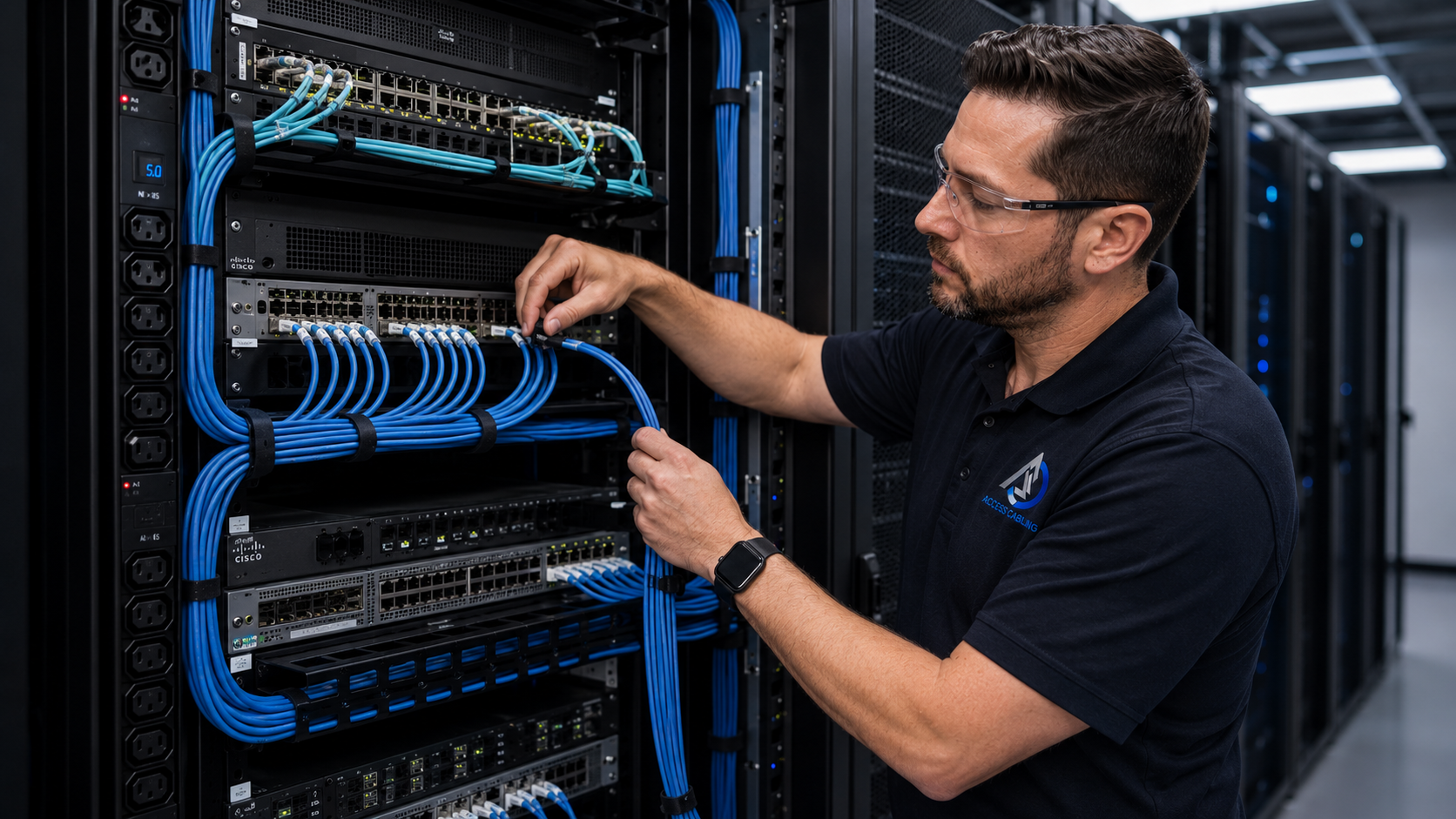
Our installation methodology for airport cabling projects is characterized by rigorous adherence to structured cabling best practices, often exceeding mere compliance. For airside installations, this involves specialized equipment for trenching, direct burial, and directional boring to establish underground pathways without disrupting active runways or taxiways. Our teams are certified in specific airport security protocols, including SIDA badging and escorted access, ensuring safe and compliant operations within restricted areas. Cable pulling techniques are meticulously managed to avoid exceeding manufacturer-specified pull tension and bend radii, crucial for preserving fiber optic integrity and copper cable performance, especially for delicate multimode and single-mode fibers. We utilize high-capacity cable management systems, ensuring proper segregation of power and data cables to prevent interference, and employ color-coding schemes consistent with TIA-606-C for ease of identification and future maintenance. All terminations, whether copper (T568B standard) or fiber (splice or pre-terminated), are executed by certified technicians, ensuring optimal signal transmission and low loss. Particular emphasis is placed on grounding and bonding protocols per TIA-607-C and NEC Article 250, critical for mitigating transient voltages, lightning strikes, and ensuring EMI protection. The precision of our installation extends to the labeling of every cable run, patch panel port, and termination point, essential for simplified troubleshooting and efficient infrastructure management in complex airport environments. This level of detail is paramount, as an incorrectly installed cable can lead to intermittent issues, which are significantly more challenging and costly to diagnose and rectify in an operational airport setting than in a typical commercial building. Furthermore, all work is coordinated with active airport operational schedules to minimize disruption.
Rigorous Testing, Certification, and Documentation
Post-installation, Access Cabling implements a comprehensive testing and certification regimen that ensures every cable drop and fiber link meets or exceeds TIA/ISO performance standards. For copper cabling (Category 6A), we utilize Fluke DSX-8000 CableAnalyzers to perform Level 2G or 2Gf field tests, measuring insertion loss, return loss, near-end crosstalk (NEXT), far-end crosstalk (FEXT), powersum NEXT, alien crosstalk (ANEXT/AFEXT), and propagation delay/delay skew. All tests are conducted bi-directionally to ensure end-to-end link performance across the specified frequency range (up to 500 MHz for CAT6A). For fiber optic cabling, we perform Tier 1 certification using an Optical Loss Test Set (OLTS) like the Fluke CertiFiber Pro, measuring insertion loss (IL) at multiple wavelengths (850/1300nm for multimode, 1310/1550nm for single-mode) in compliance with TIA-568.3-E. For critical links or long-haul fiber, Tier 2 certification is performed using an Optical Time Domain Reflectometer (OTDR) such as the Fluke OptiFiber Pro, which provides graphical trace analysis of splices, connectors, and cable length, identifying any potential anomalies. Upon successful certification, clients receive detailed test reports in PDF or LinkWare Live format, offering granular data for every tested link, accompanied by as-built drawings and comprehensive cabling infrastructure documentation conforming to TIA-606-C specifications. This robust certification process provides an unimpeachable guarantee of network performance, traceability, and simplifies future maintenance or expansion efforts, often a mandatory requirement for airport authority acceptance. This rigorous approach not only validates the physical integrity of the network but also provides a vital audit trail for compliance purposes.
Critical Applications Supported: Beyond Basic Connectivity
Airport cabling infrastructure extends far beyond typical office connectivity, supporting an intricate web of specialized, mission-critical applications across both airside and landside functions. For airside operations, this includes networks for AGL (Airfield Ground Lighting) control systems, FOD (Foreign Object Debris) detection systems, advanced perimeter intrusion detection, ground radar, and aircraft docking guidance. These systems demand ultra-low latency and exceptionally high reliability, often leveraging redundant fiber optic paths. On the landside, robust cabling underpins passenger information displays (FIDS/BIDS), common use terminal equipment (CUTE/CUSS) for check-in and self-service kiosks, access control systems (ACS) for secure areas, IP-based CCTV surveillance (e.g., SITA, Genetec), public address systems, and emergency communication networks. Furthermore, the burgeoning demand for high-density Wi-Fi for passengers and IoT devices within the airport environment requires a high-capacity, distributed antenna system (DAS) or Wi-Fi 6/6E backbone reliant on densely cabled access points. Baggage handling systems, which are increasingly automated and reliant on real-time data exchange, also depend on a fault-tolerant network. Our expertise ensures that the physical layer is designed specifically for the unique bandwidth, security, and environmental requirements of each of these disparate, yet interconnected, airport systems. We understand that each of these applications has distinct cabling and network performance profile requirements, and our designs are tailored to meet those specific demands, ensuring that the network is not a bottleneck but an enabler of efficient airport operations.
Ensuring Compliance, Security, and Redundancy
Compliance and security are non-negotiable pillars in airport cabling. Our deployments strictly adhere to FAA regulations pertaining to safety of flight, specifically addressing potential electromagnetic interference (EMI) with critical navigation and communication systems. We integrate physical security measures into our designs, such as hardened cable pathways, locked enclosures, and strict access protocols for riser closets and equipment rooms, aligning with TSA security directives for critical infrastructure. Redundancy is engineered at multiple levels: often employing diverse routing of primary and secondary cable pathways, redundant fiber optic links for critical systems, and dual-homed network devices to prevent single points of failure. This fault-tolerant design minimizes the impact of accidental cuts or equipment failures, ensuring continuous operation. Given the highly regulated nature of airports, all designs and installations are meticulously documented to facilitate audits by governing bodies. Our project management methodology includes rigorous risk assessments, identifying and mitigating potential vulnerabilities from both an operational and cybersecurity perspective. We implement best practices for grounding and bonding, essential not only for electrical safety but also for protecting sensitive electronics from electrical transients and achieving optimal signal integrity in EMI-rich environments. The goal is to deliver a network infrastructure that is not only high-performing but also demonstrably secure, resilient, and fully compliant with the complex web of aviation-specific standards and mandates, providing peace of mind for airport authorities and operators. This comprehensive approach to compliance also means that our team remains current on all evolving regulatory changes affecting airport infrastructure.
Optimizing Project Lifecycle Management for Airport Infrastructure
Effective project lifecycle management in airport cabling deployments transcends conventional IT rollouts, demanding a multi-faceted approach that integrates stringent aviation-specific methodologies with robust construction management principles. Our process begins with detailed scope definition, meticulously outlining connectivity requirements for ATC towers, radar systems, passenger terminals, baggage handling systems, and ground support operations. This includes identifying specific data rates for critical flight operations (e.g., Cat6A for 10Gbps air traffic control data uplinks, fiber optic solutions like OS2 single-mode for long-haul inter-facility backbone links exceeding 300 meters), power-over-Ethernet (PoE) requirements for IP cameras and access control, and specialized shielding for electromagnetic interference (EMI) prone environments such as those near radar installations. We leverage PRINCE2 and PMBOK frameworks, tailoring them to aviation project phases, which often involve complex stakeholder coordination including airport authorities, airlines, FAA/EASA officials, security agencies, and multiple co-located contractors (e.g., HVAC, electrical, fire suppression). A critical early deliverable is a comprehensive Statement of Work (SOW) detailing all contractor responsibilities, interface points, and a detailed Work Breakdown Structure (WBS) that segments the project into manageable, auditable tasks. Risk assessments are performed continuously, addressing potential delays due to weather, security clearances, equipment procurement lead times for specialized components (e.g., airfield-grade armored fiber), and the dynamic nature of airport operations which often require nighttime or off-peak work windows to minimize disruption.
Coordination with MEP (Mechanical, Electrical, and Plumbing) trades is paramount to prevent clashes and ensure optimal cable routing pathways. Early engagement in BIM (Building Information Modeling) processes allows for visualizing cable trays, conduits, and equipment rack placements in a 3D environment, identifying potential conflicts with ventilation ducts, sprinkler systems, or high-voltage lines BEFORE physical installation. This collaborative approach significantly reduces redesigns and reworks during the construction phase. Our project managers are adept at navigating the stringent Material Safety Data Sheet (MSDS) requirements for all cabling components, including fire-rated jackets (LSZH – Low Smoke Zero Halogen) and hazardous material protocols for specialized installation lubricants or cleaning agents. Furthermore, we implement a rigorous change management protocol, ensuring that any deviation from the baseline project plan is formally documented, assessed for impact on schedule and budget, and approved by all relevant stakeholders. This meticulous project discipline ensures predictable outcomes, adherence to strict timelines under operational constraints, and a final infrastructure that meets both performance metrics and longevity expectations.
Navigating Regulatory Compliance and Aviation-Specific Standards
Adherence to a labyrinth of regulatory mandates and industry-specific standards is non-negotiable for airport cabling infrastructure. Beyond generic building codes, we rigorously conform to FAA Advisory Circulars (ACs), particularly AC 150/5370-10H (Standards for Specifying Construction of Airports), which outlines technical specifications for communication conduits and pathways on airfield property, and AC 150/5340-30J (Standards for Airport Sign Systems), which dictates powering and data requirements for critical airfield lighting and signage. For European projects, EASA (European Union Aviation Safety Agency) requirements, specifically CS-ADR-DSN (Certification Specifications for Aerodrome Design), heavily influence our design and material selection, emphasizing redundancy, fire safety, and environmental protection. Data security protocols must align with TSA (Transportation Security Administration) regulations in the US and equivalent bodies internationally, particularly for systems handling Passenger Name Records (PNR) or critical operational data. This often necessitates physical segregation of networks, deployment of hardened enclosures, and strict access controls for network closets and data centers.
Our engineering team possesses a deep understanding of BICSI (Building Industry Consulting Service International) standards, specifically their Transportation Distribution Design (TDD) manual, which provides best practices for telecommunications infrastructure in transportation environments. We prioritize TIA/EIA-568 series for structured cabling performance, TIA/EIA-942 for data center infrastructure, and IEEE 802.3 for Ethernet specifications, ensuring that all deployed active and passive components meet or exceed these benchmarks. Critically, we navigate NFPA 70 (National Electrical Code) for wiring practices, focusing on specialized sections for critical infrastructure and emergency power, and NFPA 75 for fire protection of information technology equipment. All deployed firestopping materials, for instance, must comply with ASTM E814 (UL 1479) for through-penetration fire stop systems. Material selection is also heavily influenced by aviation environmental factors: cables used near runways or in underground conduits must be resistant to jet fuel, de-icing agents, UV radiation, and extreme temperature fluctuations, often requiring plenum-rated LSZH jackets, armored fiber, and specialized weather-resistant enclosures rated to NEMA 4X or IP67. Detailed documentation provided includes Certificates of Conformance (CoCs) for all materials, demonstrating compliance with ISO 9001 quality management systems and relevant environmental certifications.
Implementing Robust Redundancy and Disaster Recovery Strategies
Airport operations demand uninterrupted connectivity, making robust redundancy and comprehensive disaster recovery strategies integral to every cabling infrastructure design. Our approach incorporates physical infrastructure diversity through geographically separated pathways and active equipment duplication. For mission-critical systems like Air Traffic Control (ATC) voice and data, we implement 2N or N+1 redundancy at every layer: dual fiber optic backbone pathways routed via separate conduits and building risers, redundant core switches in different server rooms, and duplicated power feeds (often from A and B grids backed by UPS and generators). This physical separation provides resilience against accidental cable cuts, localized equipment failures, or environmental hazards like flooding in a specific conduit run. We utilize multi-path routing protocols like OSPF or BGP with fast convergence timers to ensure seamless failover in the event of a link or device failure, often achieving sub-50ms recovery times for critical data flows.
Beyond physical redundancy, our designs incorporate logical redundancy through advanced network architectures. For instance, creating Virtual Router Redundancy Protocol (VRRP) or Hot Standby Router Protocol (HSRP) groups for gateway devices, and implementing link aggregation (LAG) across multiple physical ports to increase bandwidth and provide path redundancy for high-traffic servers or storage area networks (SANs). We also pay meticulous attention to passive component redundancy: utilizing dual patch panels connected to separate network switches, deploying pre-terminated trunk fiber assemblies with spare strands, and specifying modular connectivity components for rapid replacement. A critical aspect of disaster recovery planning involves detailed documentation of all logical and physical pathways, including GIS mapping of underground conduits and fiber splice enclosures, and maintaining readily available spare parts inventories for all proprietary and specialized components. Our cutover plans for upgrades or migrations are designed with ‘rollback’ options, utilizing temporary parallel systems or dark fiber activation to ensure minimal downtime. Furthermore, we integrate comprehensive monitoring systems that provide real-time alerts on link status, optical power levels, and equipment health, allowing for proactive maintenance and rapid incident response, mitigating potential outages before they impact critical airport functions.
Ensuring Long-Term Maintainability and Total Cost of Ownership
Designing airport cabling infrastructure purely for initial deployment cost often leads to significantly higher Total Cost of Ownership (TCO) over its operational lifespan, which for critical airport systems can exceed 20 years. Our designs prioritize long-term maintainability and operational efficiency, significantly reducing future CapEx and OpEx. This begins with meticulous documentation: a comprehensive ‘as-built’ package including detailed floor plans with cable routes, rack elevation diagrams, fiber splice diagrams, and full labeling schemas for every cable, patch panel port, and network device. We use industry-standard naming conventions (e.g., ANSI/TIA-606-C) for all permanent links and active equipment, enabling rapid fault identification and resolution by airport IT and maintenance staff, even years after installation. Clear, color-coded cable management in racks and pathways, utilizing proper bend radius controls and strain relief, not only enhances performance but also simplifies future additions, moves, and changes (MACs).
Material selection plays a crucial role in TCO. Investing in high-quality, durable cabling components (e.g., industrial-grade connectors, armored fiber optic cables, plenum-rated jackets with superior flame resistance) reduces the frequency of replacements and repairs, especially in harsh or high-traffic environments. We often specify modular components and scalable architectures that allow for seamless upgrades (e.g., transitioning from 1Gbps to 10Gbps Ethernet, or expanding fiber capacity without re-cabling entire runs) to avoid costly rip-and-replace scenarios as technology evolves. Furthermore, our designs emphasize energy efficiency, particularly for active equipment and Power over Ethernet (PoE) deployments, contributing to lower utility costs for the airport. We provide comprehensive training to airport staff on the infrastructure’s layout, documentation, and basic troubleshooting, fostering self-sufficiency. Finally, we propose structured maintenance contracts that include regular health checks, optical time-domain reflectometer (OTDR) testing for fiber integrity, and thermal imaging of active equipment, extending the lifespan of the infrastructure and detecting potential issues proactively before they escalate into network-wide failures, ultimately ensuring a lower TCO and sustained operational excellence.