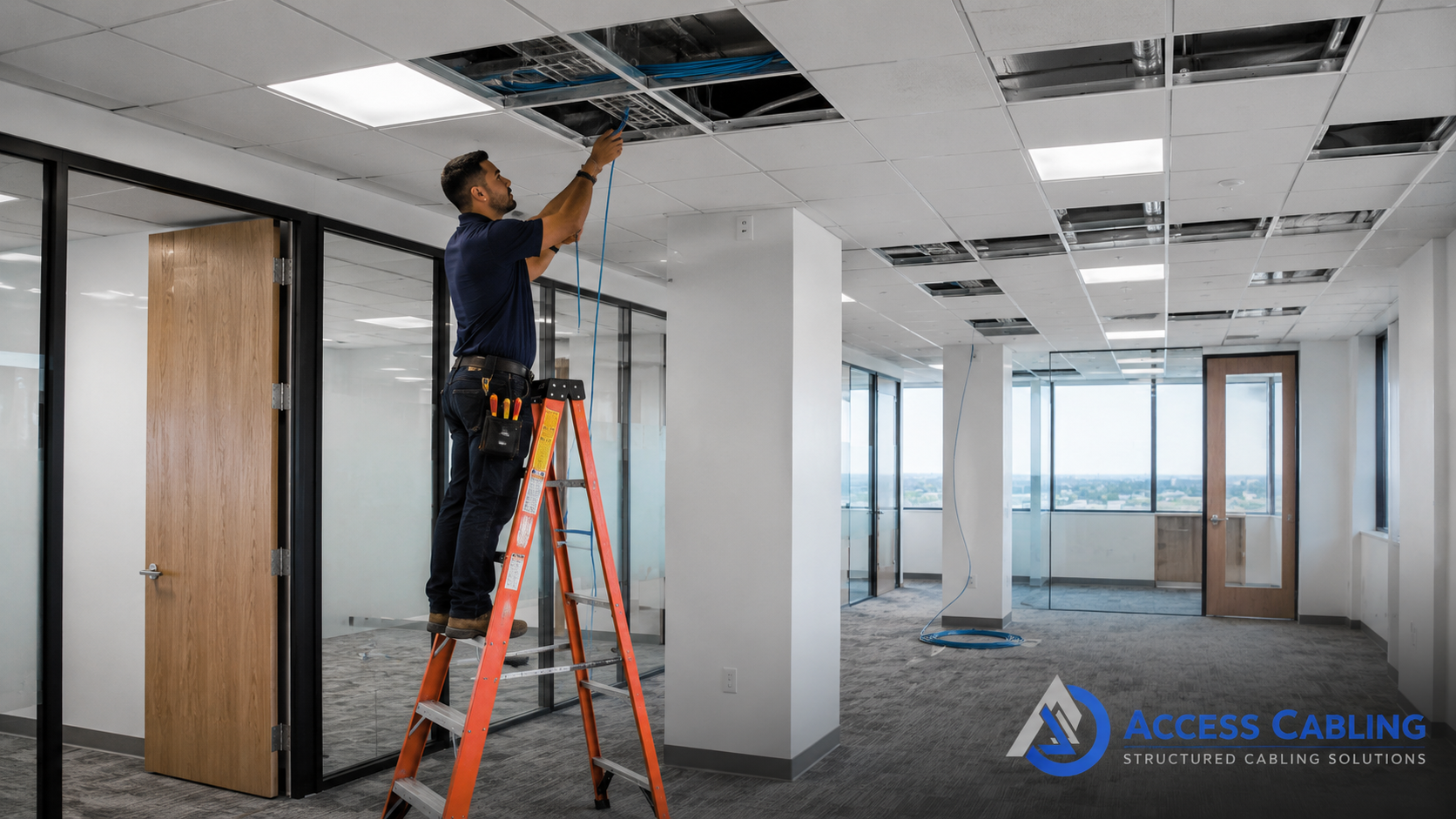
Developing and maintaining robust, secure, and compliant network infrastructure for federal, state, and municipal entities presents unique challenges far beyond typical commercial deployments. Government cabling demands an intricate understanding of stringent regulatory frameworks, long-term scalability, and uncompromised data integrity. As a licensed C-10/C-7 low-voltage contractor (CSLB 992009) with 28+ years of experience, Access Cabling specializes in delivering mission-critical cabling solutions tailored specifically for government operations. Our expertise spans classified environments, public safety networks, administrative facilities, and distributed agency campuses, ensuring network resilience and performance while adhering to TIA/EIA, BICSI, NEC, and agency-specific mandates. We provide end-to-end design, installation, and certification for copper and fiber optic systems that support high-bandwidth applications, secure data transmission, and future technology integration, mitigating risks and optimizing operational continuity for government entities across California and nationwide.
Upholding Regulatory Compliance in Government Cabling Deployments
Government cabling projects are inherently complex due to the overarching requirement for strict adherence to numerous regulatory standards and mandates. Beyond baseline TIA/EIA commercial building telecommunications cabling standards (e.g., TIA-568 series for balanced twisted-pair and optical fiber, TIA-569 for pathways and spaces, TIA-606 for administration, TIA-607 for grounding and bonding), federal agencies must often comply with specific directives. This includes adherence to the National Electrical Code (NEC) for all electrical and safety aspects, Federal Information Security Management Act (FISMA) guidelines for securing critical data, and potentially FIPS 201 for PIV (Personal Identity Verification) interoperability in access control systems, which directly impacts integrated security cabling. Furthermore, Department of Defense (DoD) facilities often operate under Unified Facilities Criteria (UFC) standards like UFC 3-580-01 for Telecommunications Infrastructure, demanding advanced security measures for EMSEC (Emissions Security) and often requiring specialized conduit systems and classified area protection. State and local government projects, while still adhering to NEC and TIA, frequently incorporate state-specific building codes and public safety communication requirements, such as those for Emergency Operations Centers (EOCs) or 911 dispatch facilities, which necessitate redundant power and network paths. Access Cabling's rigorous approach ensures all installations meet and exceed these multi-layered compliance requirements, from infrastructure design to material selection and final commissioning.
Strategic Design and Engineering for Government Infrastructure
Effective network design for government entities prioritizes security, redundancy, scalability, and long-term maintainability. Our engineering process begins with thorough site assessments and a detailed understanding of the agency's mission, anticipated data loads, and classification levels. We utilize industry-leading design principles, often incorporating diversified pathways and spaces to protect critical fiber and copper backbones, as specified in TIA-569-D. For secure facilities, this includes evaluating conduit fill ratios (NEC Article 300.17), specifying electromagnetic shielding for Sensitive Compartmented Information Facilities (SCIFs), and implementing physical security measures for telecommunications rooms and equipment. We design for future-proof scalability by often recommending high-density fiber optic solutions, such as OM4 or OS2, and Category 6A or even Category 7A shielded copper for high-bandwidth applications and improved alien crosstalk performance. Redundancy planning is critical, encompassing redundant power feeds, active/standby network equipment, and geographically dispersed data centers when applicable. Our designs account for environmental conditions, firestopping requirements (NEC Article 300.21 and BICSI TDMM guidelines), and proper airflow management within telecommunications rooms to maintain optimal operating temperatures for active equipment, ultimately minimizing single points of failure and maximizing network uptime.
Specifying Robust Materials for Government Deployment Longevity
The selection of cabling components and hardware for government projects extends beyond commercial-grade performance to encompass enhanced security, durability, and compliance. We specify products from trusted manufacturers like Corning, Panduit, CommScope, Leviton, and Belden, known for their adherence to stringent manufacturing standards and certifications. For backbone infrastructure, armored fiber optic cables (e.g., Corning FREEDM® One loose tube armored) are common in outdoor or campus environments to guard against physical damage and rodent intrusion. Inside facilities, plenum-rated (CMP) or riser-rated (CMR) jackets are mandated by NEC Article 770.83 for fire safety. For secure data transmission, shielded twisted-pair (STP) copper cabling (e.g., Belden 10GX Shielded) or fiber optic solutions are frequently deployed to mitigate EMI/RFI and reduce the risk of electromagnetic eavesdropping, especially for TEMPEST-compliant areas. Rack and cabinet solutions from Panduit or CommScope are selected for robust physical security, often featuring locking mechanisms, perforated doors for cooling, and integrated cable management. Grounding and bonding components are critical (TIA-607-C), ensuring a low-impedance path to ground for all metallic network infrastructure, and often require specialized telecommunications bonding backbones (TBB) and grounding electrodes for sensitive equipment and electromagnetic compatibility. Every component is chosen for its ability to meet performance specifications over an extended lifecycle, resisting environmental factors and supporting sustained high-bandwidth operations.
Precision Installation Protocols for Government Facilities
The installation phase of government cabling projects adheres to meticulously defined protocols, prioritizing precision, safety, and operational continuity for critical services. Our certified technicians follow BICSI ITS Installer and Designer guidelines, along with TIA-568 standards for termination and cable routing. Rack and cabinet installations are executed to TIA-942 Telecommunications Infrastructure Standard for Data Centers specifications, ensuring proper grounding, airflow, cable management for power and data segregation, and secure access. For fiber optic deployments, fusion splicing is performed using calibrated equipment (e.g., Fujikura fusion splicers) to minimize insertion loss, with all splices housed in appropriate splice enclosures or cabinets. Copper cable pathways are installed to prevent excessive bending radii (TIA-568.3), proper support (NEC Article 800.24), and separation from power cables to avoid interference. In established government facilities, particular care is taken during retrofit and expansion projects to minimize disruption to ongoing operations, often requiring off-hours or phased installations. For secure environments like SCIFs, installers follow strict access control procedures, maintain chain-of-custody for all materials, and adhere to specific construction standards, including the use of shielded conduits and penetration seals to prevent unauthorized compromise. Final documentation includes ‘as-built’ drawings and detailed labeling (TIA-606-C) for every cable, pathway, and termination point, crucial for long-term management and maintenance, especially in multi-building government campuses.
Comprehensive Testing and Certification for Government Networks
Post-installation, rigorous testing and certification are paramount to validate the performance and reliability of government network infrastructure. Each installed copper link (e.g., Category 6A) undergoes comprehensive testing using certified Fluke Networks DSX-8000 Versiv Cable Analyzers to ensure compliance with TIA-568-C.2 or TIA-568.2-D permanent link and channel specifications. This includes measuring parameters such as Near-End Crosstalk (NEXT), Far-End Crosstalk (FEXT), Return Loss, Insertion Loss, and length, with results documented electronically. For fiber optic systems, Optical Loss Test Set (OLTS) testing, per TIA-568.3-E, is performed to measure end-to-end attenuation, ensuring it meets the calculated link loss budget for specified fiber types (e.g., OM4, OS2). Optical Time Domain Reflectometer (OTDR) testing (e.g., using Fluke OptiFiber Pro units) is also conducted on all fiber optic backbone links to verify splice performance, identify continuity issues, and pinpoint exact fault locations, providing a comprehensive characterization of the installed fiber plant. All test results are compiled into detailed certification reports, providing verifiable proof of compliance and performance, which is a critical deliverable for government audits and operational readiness, substantiating the infrastructure's ability to support mission-critical applications and meet defined Service Level Agreements (SLAs).
Key Applications and Use Cases in Government Sectors
Access Cabling's government services support a wide array of vital applications across various federal, state, and municipal sectors. For justice and public safety agencies, this includes robust cabling for Emergency Operations Centers (EOCs), 911 dispatch centers, police and fire stations, and correctional facilities, requiring high-availability, low-latency infrastructure for unified communications, video surveillance, and computer-aided dispatch (CAD) systems. In federal civilian and defense sectors, we deploy secure networks for administrative offices, research laboratories, command and control centers, and data processing facilities, which demand classified area cabling, physical security integration, and support for high-performance computing clusters and secure VoIP systems. For state and local government, our services extend to city halls, courthouses, public works departments, and schools, enabling e-government initiatives, citizen services, facility management systems, and smart city technologies that rely on advanced IoT (Internet of Things) sensor networks and robust wireless backbones. Each application necessitates a tailored approach to bandwidth planning, security hardening, and redundancy, ensuring that the critical functions of government are supported by an infrastructure that is both reliable and resilient against evolving threats and operational demands.
Ensuring Data Integrity and Physical Security Postures
In government environments, data integrity and physical security are not merely preferences but constitutional requirements. Our cabling solutions are intrinsically designed to fortify these postures. This includes implementing physical layer security measures such as secure conduits (e.g., rigid nonmetallic conduit or EMT), locked telecommunications rooms (TR), and integrated access control systems to restrict unauthorized access to network infrastructure. We consider methods to mitigate electromagnetic interference (EMI) and radio frequency interference (RFI) to protect classified data, often specifying shielded cabling (e.g., Category 6A F/UTP or S/FTP) and ensuring proper grounding and bonding throughout the system to create a reliable Faraday cage effect where necessary. For facilities handling Sensitive Compartmented Information (SCI), we adhere to the most stringent installation practices, including the use of specialized interducts, and hardened entry points, often incorporating intrusion detection systems directly integrated with the physical network infrastructure. Our designs minimize the risk of signal leakage and unauthorized data interception, delivering a layered defense strategy that extends from the physical cable plant to the active network devices, aligning with best practices for cyber-physical security and safeguarding critical government information assets.
Access Cabling’s Differentiated Approach to Government Projects
What sets Access Cabling apart in the government sector is our comprehensive understanding of the unique challenges and statutory requirements that define these projects. Our 28+ years of specialized experience as a C-10/C-7 contractor (CSLB 992009) ensures we deliver not just functional infrastructure, but highly compliant, secure, and future-ready systems. We employ BICSI-certified RCDDs (Registered Communications Distribution Designers) and certified technicians who possess the requisite clearances and expertise to work in sensitive government environments. Our project management methodology is built around transparency, accountability, and stringent adherence to timelines and budgets, understanding the constraints and procurement processes inherent in government contracts. We utilize manufacturer-agnostic expertise to select the optimal components, whether from Panduit, CommScope, Leviton, Belden, or Corning, prioritizing performance and longevity over brand loyalty. Furthermore, our commitment to providing meticulous, TIA-606-C compliant documentation, comprehensive Fluke DSX certification reports, and robust warranties provides government agencies with absolute assurance in their critical network investments. We act as a trusted partner, translating complex security mandates and operational needs into resilient, standards-compliant cabling infrastructures that underpin essential government services.
Navigating Procurement and Contracting for Government Initiatives
Engaging with government entities for cabling infrastructure projects necessitates a profound understanding of their unique procurement landscapes and contracting mechanisms. Unlike commercial ventures, these projects often operate under strict regulatory frameworks such as FAR (Federal Acquisition Regulations) for federal contracts, or state-specific codes like the California Public Contract Code. Our approach commences with a meticulous analysis of the Request for Proposal (RFP) or Invitation for Bid (IFB), ensuring complete adherence to all specified technical requirements, socioeconomic set-asides (e.g., small business, veteran-owned), and contractual clauses including CUI (Controlled Unclassified Information) handling, PII (Personally Identifiable Information) safeguards, and cybersecurity mandates like NIST SP 800-171. We prepare comprehensive bid packages that not only detail our technical capabilities for deploying infrastructure like Cat6A F/UTP for secure VoIP and data, or OM4 fiber optic backbones for large data centers, but also meticulously outline our proposed project management methodologies, quality assurance protocols, and adherence to prevailing wage requirements as stipulated by acts like the Davis-Bacon Act. This includes providing precise estimations for materials such as plenum-rated LSZH (Low Smoke Zero Halogen) cabling meeting NFPA 262, and specialized conduit systems for EMI/RFI mitigation, coupled with labor costs, incorporating burden rates and certified payroll submission protocols. A critical aspect involves delineating our subcontractor management strategy, pre-qualifying all partners to meet stringent government security clearances and technical proficiencies. Furthermore, we develop detailed project schedules leveraging critical path method (CPM) analysis, identifying potential delays related to GFE (Government Furnished Equipment) lead times or secure facility access procedures, and formulating robust risk mitigation strategies. Our documentation suite for proposals extends beyond technical specifications to include comprehensive financial disclosures, insurance certificates (e.g., professional liability, cyber liability), and past performance references that directly showcase our experience in regulated environments, thereby demonstrating our capacity to manage complex, multi-phase projects with exacting fidelity to contractual terms and budget constraints, often under fixed-price or time-and-materials structures with stringent cost accounting standards.
Integrated Security Layers for Converged Government Networks
The integration of physical and logical security layers within government cabling infrastructure is paramount, extending beyond mere data transmission to encompass comprehensive threat mitigation. Our designs prioritize a converged security architecture, where the physical cabling plant itself becomes a critical component of the overall security posture. This involves the strategic deployment of hardened fiber optic solutions, including armored fiber (e.g., steel tape armored OS2 for outdoor runs) and discreet, micro-duct systems within secure conduits, to prevent unauthorized tapping and physical sabotage. For copper-based systems, we implement shielded twisted pair (STP) cabling up to Cat7A in sensitive areas, significantly reducing electromagnetic interference (EMI) and minimizing susceptibility to eavesdropping techniques through Tempest certification considerations, where applicable. Endpoint security is further enhanced by utilizing tamper-resistant network enclosures (e.g., NEMA 4X rated for environmental protection and physical access control), specialized cabinet locks, and integration with facility access control systems (PACS) that leverage biometrics or cryptographic keycards. The network segmentation strategy is deeply embedded in the physical layout, utilizing separate cable bundles and distinct pathways for different security enclaves (e.g., unclassified, classified secret, classified top secret, as per DoD and intelligence community directives), alongside dedicated pathways for Building Management Systems (BMS) and physical security systems like IP-based CCTV within a Video Management System (VMS) infrastructure. This segmentation is not just logical (VLANs), but physically enforced to prevent cross-domain contamination. Furthermore, our designs incorporate advanced environmental monitoring sensors within data centers and telecommunications rooms (TRs) – detecting temperature fluctuations, humidity levels, smoke, and unauthorized entry – which are integrated into a centralized security incident and event management (SIEM) platform for real-time threat detection and response. We also consider the 'air gap' principle for highly sensitive networks, which necessitates completely isolated cabling infrastructures with no physical or logical connectivity to less secure networks, deploying dedicated power, grounding, and pathway systems to eliminate any potential vectors for data exfiltration or unauthorized access, thereby delivering a multi-layered defense-in-depth strategy where the cabling infrastructure is an active participant in maintaining the integrity and confidentiality of government operations.
Sustainability and Life Cycle Cost Optimization in Design
Designing government cabling infrastructure goes beyond initial deployment, focusing heavily on sustainability, energy efficiency, and total cost of ownership (TCO) throughout the system's extended lifecycle. Our methodology integrates principles from LEED (Leadership in Energy and Environmental Design) and Green Globes certifications, emphasizing the selection of environmentally responsible materials. This includes specifying low-VOC (Volatile Organic Compound) and halogen-free plenum-rated cabling (e.g., LSZH jackets) to improve indoor air quality and reduce toxic emissions in case of fire, aligning with GSA PBS P100 requirements. We meticulously plan for cable pathway optimization, consolidating pathways to reduce material consumption and minimize the overall footprint of the infrastructure, thereby enhancing future expandability while reducing construction waste. Energy efficiency is a critical design driver, particularly concerning Power over Ethernet (PoE) applications in smart government buildings. We deploy high-efficiency PoE switches and optimize cable lengths for specific power delivery classes (e.g., Class 8 for 90W PoE++) to minimize transmission losses and reduce power consumption at the source, thus lowering operational electricity costs. Furthermore, we advocate for modular and scalable cabling architectures, utilizing structured cabling systems with ample spare capacity in fiber optic panels (e.g., MPO/MTP cassettes for future 400GbE upgrades) and copper patch panels to facilitate future technology refreshes and expansions without necessitating a complete re-pull of the horizontal or backbone cabling. This 'future-proofing' minimizes disruption, labor costs, and material waste for subsequent upgrades. Life cycle cost analysis extends to selecting materials with extended warranties and proven durability, reducing the frequency of repairs and replacements. We specify robust conduit systems, firestopping materials adhering to UL 1479, and proper grounding and bonding techniques (per BICSI ITSIMM and TIA-607-C) to ensure system longevity and mitigate environmental degradation. Documentation plays a crucial role in TCO, with comprehensive as-built drawings, labeling schemes (e.g., TIA-606-C compliant), and digital infrastructure management (DIM) tools enabling efficient troubleshooting, asset tracking, and maintenance scheduling, ultimately extending the useful life of the infrastructure and providing significant long-term budgetary advantages for government agencies facing persistent fiscal constraints.
Post-Installation Support and Continuous Operational Readiness
Ensuring the continuous operational readiness of government cabling infrastructure requires a robust post-installation support framework that extends well beyond project handover. Our commitment includes comprehensive close-out documentation packages, which are critical for long-term maintenance and compliance. These packages meticulously detail every aspect of the deployed infrastructure, including as-built drawings generated from CAD, GIS, or BIM models, specifying exact cable routes, termination points, IDF/MDF locations, and equipment racks. We provide complete test results for every cable run (e.g., Fluke DSX-8000 compliance reports for Category 6A, OTDR traces for fiber optic links per TIA-568.3-D), guaranteeing performance to TIA/ISO standards. Furthermore, detailed component manifests with serial numbers, warranty information, and recommended spare parts lists are supplied. Beyond documentation, we offer multi-tiered support contracts tailored to government operational tempos. These agreements range from 24/7 emergency response for critical infrastructure failures (e.g., a damaged fiber backbone impacting a command center) to scheduled preventive maintenance, which includes visual inspections of cable pathways, re-certification of aging copper links, and cleaning of fiber optic connectors to prevent signal degradation from contamination (e.g., fusion splicer cleaning procedures). Our support services also encompass proactive monitoring solutions that track network performance metrics, detect anomalies, and predict potential points of failure before they impact operations. This includes monitoring physical layer events such as power fluctuations, temperature excursions in telecommunications rooms, or unauthorized cabinet access. We provide detailed training for government IT staff on the new infrastructure, covering topics from patch management best practices and media converter deployment to basic troubleshooting and the interpretation of testing reports. Moreover, our support framework includes change management protocols, ensuring that any modifications or expansions to the cabling plant are meticulously documented, adhere to existing standards, and are seamlessly integrated into the operational environment, maintaining the strict security and reliability requirements demanded by government agencies. This continuous engagement ensures that the cabling infrastructure remains a resilient, high-performing foundation for mission-critical operations, minimizing downtime and optimizing network availability for personnel and data assets.