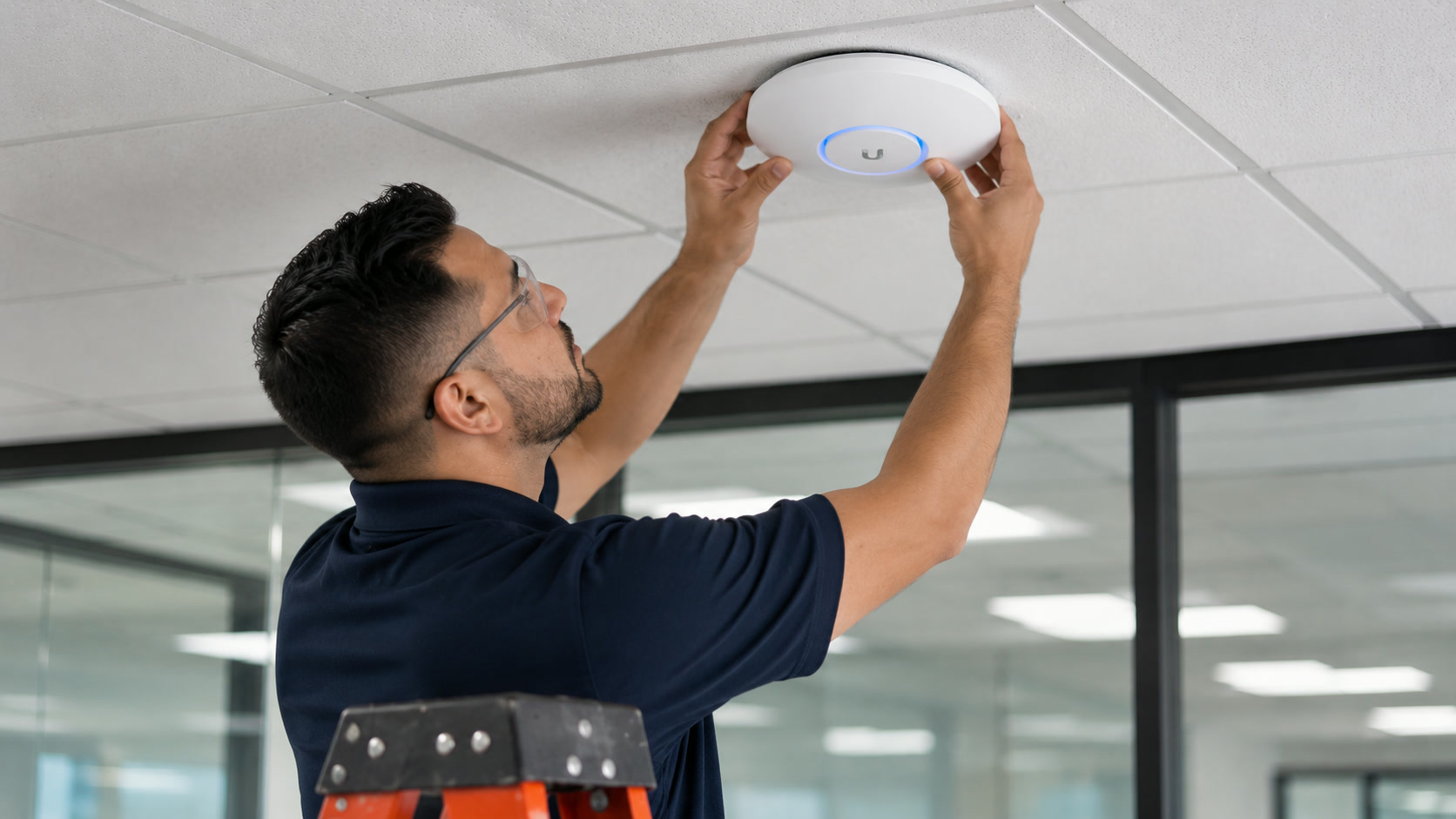
Developing and maintaining robust, reliable, and secure network infrastructure for K-12 educational institutions presents unique challenges, requiring specialized expertise in design, deployment, and ongoing support. Access Cabling provides comprehensive school cabling solutions tailored to the specific demands of dynamic learning environments, integrating high-performance data, voice, video, and security systems. Our approach prioritizes scalability, resilience, and adherence to all relevant industry standards, including TIA, BICSI, and NEC, while also navigating the complexities of E-Rate documentation and compliance. We understand that educational networks are critical for modern pedagogical methods, administrative functions, and campus safety. As a deeply experienced C-10/C-7 contractor, we deliver future-ready cabling infrastructure that supports everything from classroom Wi-Fi and interactive whiteboards to IP surveillance and emergency notification systems, ensuring uninterrupted operation for students and staff across entire districts or individual campuses.
K-12 Network Standards, Compliance, and E-Rate Support
Effective school cabling deployments must strictly adhere to industry and regulatory standards, which form the backbone of a reliable and compliant network. Our designs and installations consistently meet or exceed TIA-568-D series for commercial building telecommunications cabling, TIA-569-C for telecommunications pathways and spaces, and TIA-606-C for administration infrastructure. Specifically for K-12, this involves ensuring appropriate pathway sizing for future expansion, considering the high-density Wi-Fi deployments, and robust grounding and bonding per TIA-607-B. Furthermore, all work complies with the National Electrical Code (NEC) articles relevant to low-voltage cabling, particularly Article 800 (Communications Circuits) and Article 770 (Optical Fiber Cables), to guarantee electrical safety and performance. A significant aspect of our service for schools is navigating the E-Rate program. We provide meticulous documentation support, ensuring our infrastructure proposals and deployed solutions align with E-Rate Category 2 eligible services, facilitating funding acquisition for internal connections. This includes detailed bill of materials, structured cabling diagrams, and explicit descriptions of work performed, all formatted to meet USAC requirements. Our expertise streamlines the E-Rate application and compliance process, helping schools maximize their allocated funding for critical infrastructure upgrades.
Robust Design for High-Density Classroom & Administrative Use
Designing a school cabling infrastructure goes beyond merely running cables; it requires a deep understanding of concurrent user density, application demands, and future technology integration. High-density areas, such as classrooms, libraries, computer labs, and administrative offices, necessitate careful planning for both wired and wireless connectivity. For wired drops, we typically specify a minimum of two Category 6A runs per workstation or access point location to accommodate immediate needs and provide redundancy or growth capacity. The choice of Category 6A is crucial as it supports 10 Gigabit Ethernet over the full 100-meter channel length, a necessity for high-bandwidth applications like video conferencing, large file transfers, and streaming media prevalent in modern education. Wireless access point (WAP) placement and associated cabling are critical. Each WAP requires dedicated Category 6A cabling, often plenum-rated (CMP) to meet fire codes in air-handling spaces, run to a designated telecommunications room (TR) or server closet. Our designs incorporate distributed antenna system (DAS) principles for optimal Wi-Fi coverage across multi-story buildings and sprawling campuses, mitigating interference and ensuring consistent throughput. We factor in power-over-Ethernet (PoE) requirements for WAPs, security cameras, and VoIP phones, specifying switches and cabling (e.g., Belden Plenum 10GX or CommScope Systimax 3071E) capable of delivering sufficient power without performance degradation. Backbone cabling, typically single-mode or multi-mode fiber optic cable (e.g., Corning ClearCurve), is engineered for high-speed inter-building and inter-TR connectivity, providing bandwidth for aggregated classroom traffic and core network services.
Advanced Material Selection for Durability and Performance
The selection of cabling components in a K-12 environment must account for longevity, performance, and the potential for a more demanding physical environment than a typical office space. We exclusively specify and install enterprise-grade materials from leading manufacturers like Panduit, CommScope, Leviton, Belden, and Corning. For horizontal cabling, our standard is Category 6A Unshielded Twisted Pair (UTP) for its 10 Gigabit Ethernet capability and ease of termination, but we can also deploy Shielded Twisted Pair (STP) solutions where electromagnetic interference (EMI) is a concern, such as near high-voltage electrical equipment or industrial arts classrooms. Fiber optic cabling, the backbone of any campus network, is typically OS2 single-mode for long-haul building-to-building links exceeding 300 meters or for future-proofing against higher bandwidth demands, and OM3 or OM4 laser-optimized multi-mode for shorter intra-building runs or TR-to-TR connections. Outdoor fiber cables are armored and gel-filled for protection against environmental factors and rodent intrusion. All patch panels (e.g., Panduit DP6 Plus, CommScope SYSTIMAX) are deployed in properly managed racks and cabinets, ensuring structured organization and protection for active equipment. Outlet connectivity utilizes durable, impact-resistant faceplates and jacks (e.g., Leviton eXtreme 6A+) designed to withstand typical school wear and tear. Pathways and spaces, including conduit, cable tray, and J-hooks, are specified to BICSI guidelines to prevent cable stress, maintain bend radius, and accommodate future additions with ease. Fire-rated sleeves and sealants are employed for all penetrations to maintain building fire safety codes.
Meticulous Installation Protocols for Educational Settings
Installing network infrastructure in an operational K-12 school requires careful planning and execution to minimize disruption to learning activities and ensure student and staff safety. Our project managers coordinate closely with school administration and facilities staff to schedule shutdowns, access routes, and noisy work during off-hours, weekends, or academic breaks whenever possible. All technicians adhere to strict safety protocols, including background checks as often required by school districts, proper use of PPE, and secure storage of tools and materials. Cable routing adheres to TIA-569-C standards, utilizing dedicated pathways and ensuring proper separation from power circuits to mitigate EMI. This includes the use of labeled conduit, cable trays, and J-hooks to support cable bundles. Termination practices are precise and consistent, following TIA-568-D T568B wiring schemes for all jacks and patch panels. All terminations are dressed neatly, free of kinks or excessive untwisting, and clearly labeled according to TIA-606-C standards for easy identification and future troubleshooting. We integrate passive optical network (PON) solutions where appropriate, leveraging fiber-to-the-desk topologies for energy efficiency and reduced cabling infrastructure in certain scenarios. Attention to detail extends to the telecommunications rooms (TRs) and main distribution frames (MDFs), ensuring proper rack and cabinet installation, cable management, grounding, and labeling of all hardware. This systematic approach ensures a clean, organized, and easily maintainable infrastructure that supports the school's operational needs.
Comprehensive Testing, Certification, and Documentation
The final phase of any school cabling project is rigorous testing and comprehensive documentation, which is paramount for warranty validation, troubleshooting, and future network planning. Every installed copper run (Category 6A) is tested from patch panel to outlet using Fluke DSX-8000 or identical network cable analyzers to certify full compliance with TIA-568-D series channel or permanent link specifications. This includes tests for wiremap, length, propagation delay, delay skew, Near-End Crosstalk (NEXT), Far-End Crosstalk (FEXT), Power Sum NEXT (PSNEXT), Power Sum FEXT (PSFEXT), Alien Crosstalk (AXT) for Category 6A, Return Loss (RL), and Insertion Loss (IL). For fiber optic cabling, we perform Tier 1 testing using Optical Loss Test Sets (OLTS) like Fluke CertiFiber Pro, measuring insertion loss at designated wavelengths (e.g., 850/1300nm for multi-mode, 1310/1550nm for single-mode), length, and polarity. Tier 2 testing using Optical Time Domain Reflectometers (OTDR) is conducted for longer runs or to pinpoint specific events within the fiber link, providing a graphical representation of the fiber's characteristics. All test results are compiled into a comprehensive report, provided to the client in both electronic (PDF) and often native file formats. This report serves as proof of performance, supports manufacturer warranty claims generally ranging from 20 to 25 years, and is critical for E-Rate audits. Alongside test results, we deliver detailed as-built drawings, schematic diagrams, pathway documentation, and a meticulous labeling scheme (e.g., consistent with TIA-606-C Class 2 or higher) for every cable, port, and patch panel, creating a complete and actionable record of the entire infrastructure.
Scalable Infrastructure for Future Educational Technologies
Modern K-12 education is continually evolving with new technological advancements, from augmented and virtual reality (AR/VR) based learning to personalized learning platforms and AI-driven educational software. Our school cabling designs prioritize scalability and future-proofing to accommodate these emerging technologies without necessitating costly forklift upgrades. By deploying Category 6A as a minimum standard for horizontal cabling, we ensure native support for 10 Gigabit Ethernet to the desktop, more than sufficient for current high-bandwidth applications and providing headroom for future demands. Our backbone fiber optic infrastructure, often leveraging OS2 single-mode fiber, is capable of supporting 40GbE, 100GbE, and beyond, ensuring the core network can handle aggregated traffic from a rapidly expanding number of devices and bandwidth-intensive applications. We design telecommunications rooms (TRs) with adequate space and power provisions for growth – ensuring sufficient rack units, cooling, and electrical circuits for additional switches, servers, and PoE devices. Conduit pathways are oversized where practical, and cable trays are specified with spare capacity to allow for future cable additions. This forward-looking approach extends to supporting specialized environments within schools, such as STEM labs requiring high-speed research network access, media production studios demanding low-latency high-bandwidth connections, and digital signage networks for campus-wide communication. Our objective is to build a foundational infrastructure that schools can confidently build upon for decades, reducing total cost of ownership and enabling seamless technology integration.
Safety, Security, and Emergency System Integration
The criticality of safety and security in K-12 environments demands robust integration of various low-voltage systems over a unified and reliable cabling infrastructure. Our expertise extends to deploying structured cabling that supports IP-based security cameras for comprehensive surveillance, access control systems for controlled entry and exit points, and intercom/PA systems for campus-wide communication and emergency notifications. High-resolution IP cameras often require Category 6A cabling with PoE+ or PoE++, ensuring sufficient power delivery over distance. Access control readers and door strike mechanisms also rely on structured cabling, integrating seamlessly with dedicated security networks. For emergency notification systems, including mass notification (e.g., paging, strobe lights, digital signage integration) and two-way voice communication, the underlying network infrastructure must be resilient and redundant. We design pathways and connectivity to industry best practices, ensuring a reliable backbone for these critical life-safety applications. This includes properly rated cabling in accordance with NEC Articles 760 (Fire Alarm Systems) and 725 (Class 1, Class 2, and Class 3 Remote-Control, Signaling, and Power-Limited Circuits) where applicable, and careful consideration of network segmentation to prioritize emergency traffic. Integration with external security monitoring services and first responder networks is also a key consideration, facilitating rapid response in crisis situations.
Access Cabling's Proven K-12 Project Execution
Our 28+ years of experience as a C-10/C-7 licensed low-voltage contractor (CSLB 992009) uniquely positions Access Cabling to execute complex school cabling projects with precision and minimal disruption. We don't employ 'off-the-shelf' solutions; instead, each project begins with a detailed site assessment and a collaborative deep dive into the school or district's specific technological requirements, pedagogical goals, and budgetary constraints. Our project management methodology is highly disciplined, ensuring clear communication, adherence to timelines, and proactive problem-solving. We understand the school calendar and work around critical academic periods, coordinating with facilities teams, IT departments, and general contractors to ensure seamless integration with ongoing operations or construction schedules. Our long-standing relationships with leading manufacturers like Panduit, CommScope, and Corning ensure access to high-quality materials and backed warranty programs. Furthermore, our dedicated E-Rate support specialists streamline the administrative and compliance aspects, removing that burden from school IT staff. By focusing on detailed engineering, robust installation practices, comprehensive testing, and transparent documentation, Access Cabling delivers durable, high-performance network infrastructure that empowers K-12 institutions to embrace the full potential of educational technology, now and for decades to come, providing a reliable foundation for learning and safety.
Uptime Resilience: Minimizing Disruptions in Learning Environments
Ensuring continuous network availability within a school environment is paramount, as downtime directly impacts instructional delivery, administrative functions, and critical safety systems. Our approach to uptime resilience begins with redundant pathway design and active-active network architectures. For mission-critical aggregation points and MDF/IDF locations, we implement dual-homed fiber optic uplinks, often deploying diverse routes to mitigate single points of failure from trenching accidents or cable damage. Power redundancy is also a key consideration, integrating Uninterruptible Power Supplies (UPS) with sufficient runtime calculation based on switch and server load, and coordinating with facility managers on generator integration for extended outages. We specify high-reliability active equipment, often with modular power supplies and fan trays, to facilitate hot-swappable replacements. Furthermore, our designs incorporate structured cabling that exceeds TIA-568-C.x and ISO/IEC 11801 Class EA/FA specifications, utilizing bend-insensitive multimode fiber (e.g., OM4 or OM5) for optical backbone and Category 6A shielded twisted pair (S/FTP) for horizontal runs to maximize signal integrity and minimize electromagnetic interference (EMI) in electrically noisy environments. We anticipate common failure modes such as accidental disconnections, port failures, and environmental stressors like temperature fluctuations, deploying robust patch management systems, clearly labeled patching fields, and environmental monitoring probes within network closets. This meticulous focus on redundancy, robust hardware, and environmental controls significantly reduces Mean Time To Recovery (MTTR) and ensures the network infrastructure can withstand unforeseen incidents, maintaining continuity for critical educational operations.
Strategic Planning: Technology Roadmap Integration and Budgetary Alignment
Effective school cabling projects extend beyond immediate installation to encompass long-term technology roadmaps and budgetary realities. Our strategic planning process involves deep collaboration with district IT leadership to understand their 3, 5, and 10-year technologyrefresh cycles, anticipated network demands from initiatives like 1:1 device programs, virtual reality labs, BYOD, and integrated security platforms. We analyze existing infrastructure limitations, identify potential bottlenecks for future bandwidth requirements (e.g., 40GbE or 100GbE upgrades in the core), and design a cabling plant that is not only robust for today but also easily upgradeable for tomorrow. This involves selecting appropriate cable types (e.g., running dark fiber today for future 100GbE, or installing Category 6A even if current active gear is only 1GbE to avoid future recabling), establishing standardized IDF locations, and planning for pathways and spaces that accommodate inevitable growth. We provide detailed cost analyses, including Total Cost of Ownership (TCO) considerations that factor in not just initial capital expenditure but also projected maintenance, energy consumption of active hardware, and future upgrade costs. By aligning our cabling design with the school’s strategic technology roadmap and financial planning, we ensure that capital investments are amortized effectively, minimizing costly rip-and-replace scenarios and maximizing the longevity and utility of the structured cabling system. This proactive approach helps school districts avoid technological obsolescence and ensures their network infrastructure remains a foundational asset supporting educational innovation rather than a recurring budget strain.
Inter-Trade Coordination: Seamless Integration with MEP and GC Schedules
Successful deployment of school cabling infrastructure necessitates meticulous inter-trade coordination, especially with Mechanical, Electrical, and Plumbing (MEP) contractors and the General Contractor (GC). Our project managers are adept at integrating cabling schedules into the overall construction timeline, recognizing that conduit installation, core drilling, and pathway creation are critical precursors often driven by other trades. We actively participate in BIM (Building Information Modeling) coordination meetings, leveraging software like Autodesk Revit to identify potential clashes between our cabling pathways and other building systems (HVAC ducts, electrical conduits, sprinkler lines) in 3D, preventing costly rework and delays on site. For example, we work closely with electrical contractors to ensure proper grounding and bonding of our telecommunications infrastructure in accordance with ANSI/TIA/EIA-607-C and NFPA 70 (National Electrical Code), avoiding ground loops and ensuring safety. We coordinate with MEP for accurate placement of power receptacles within network closets and for appropriate environmental controls (HVAC) to maintain optimal operating temperatures for active equipment, crucial for longevity and performance. Our detailed construction documents, including floor plans with cable runs, pathway diagrams, and equipment rack elevations, are shared proactively with all stakeholders to ensure a unified understanding of the project scope and minimize field conflicts. This proactive communication and detailed planning ensure that our cabling deployment is a smooth, integrated part of the larger construction or renovation project, delivering the infrastructure on time and within budget.
Post-Installation Support: Comprehensive Training and Lifecycle Management
Our commitment to school districts extends far beyond project completion, encompassing robust post-installation support, comprehensive training, and lifecycle management guidance. Upon project handover, Access Cabling provides detailed, user-friendly documentation including as-built drawings depicting actual cable routes, port assignments, and equipment locations, alongside comprehensive test results for every installed cable link (e.g., Fluke DTX/DSX Cable Analyzer reports for copper, OTDR traces for fiber). We conduct on-site training sessions for district IT staff, covering best practices for patch panel management, basic troubleshooting, understanding connectivity maps, and utilizing the provided documentation for future maintenance. This empowers school IT personnel to effectively manage their new infrastructure. Furthermore, we offer tiered support agreements, from proactive maintenance checks to emergency response services, ensuring immediate resolution for any unexpected issues. Our lifecycle management guidance includes advising on future upgrades, technology refreshes, and capacity planning based on projected demand, helping districts optimize their cabling investment over its operational lifespan. We track installed product warranties and provide guidance on warranty claims if needed. This holistic approach to post-installation support ensures that school IT teams are fully equipped to leverage their new advanced cabling system, maintaining its high performance and reliability throughout its entire service life, thereby maximizing their return on infrastructure investment.