Developing and maintaining robust, high-performance network infrastructure across an expansive university campus presents a unique set of challenges, from historic buildings to new research facilities, and from dormitories to outdoor sports complexes. University cabling demands a highly specialized approach that integrates diverse building types, anticipates future technological growth, and ensures uninterrupted connectivity for tens of thousands of users. Access Cabling, a C-10/C-7 licensed low-voltage contractor (CSLB 992009) with 28+ years of experience, specializes in designing, installing, and certifying campus-scale university cabling and Outside Plant (OSP) fiber optic networks that meet these stringent requirements. Our expertise encompasses the precise integration of structured cabling systems, both inside plant (ISP) and OSP, designed to support high-density wireless access, advanced research applications, administrative functions, and residential services, all while adhering to TIA/EIA, BICSI, and NEC standards specific to educational environments. We provide comprehensive solutions that are scalable, resilient, and architected for the long-term operational demands of higher education institutions.
Campus Structured Cabling and OSP Fiber Optic Fundamentals
Effective university cabling systems are fundamentally structured around TIA/EIA standards, specifically TIA-568 (Commercial Building Telecommunications Cabling Standard), TIA-569 (Telecommunications Pathways and Spaces), TIA-606 (Administration Standard for Telecommunications Infrastructure), and TIA-758 (Customer-Owned Outside Plant Telecommunications Infrastructure Standard). For inside plant (ISP) deployments within campus buildings, we primarily utilize Category 6A (Cat6A) unshielded twisted pair (UTP) or shielded twisted pair (STP) cabling to support 10 Gigabit Ethernet (10GbE) over distances up to 100 meters, critical for high-bandwidth applications like lecture hall AV, research lab data, and high-density Wi-Fi access points. Fiber optic cabling, particularly OS2 single-mode and OM4/OM5 multi-mode, is indispensable for university backbone infrastructure, inter-building connections, and longer-haul OSP runs. OS2 single-mode fiber is preferred for campus-wide backbones, connecting disparate buildings and data centers, due to its ability to transmit data over several kilometers with minimal signal loss, providing future-proof capacity for 40GbE, 100GbE, and beyond. OM4/OM5 multi-mode fiber is often employed for shorter-distance, high-bandwidth interconnects within data centers or between aggregation switches within a single large facility, supporting up to 100GbE over hundreds of meters. All fiber optic and copper cabling installations adhere to NEC (National Electrical Code) Article 800 standards for communications circuits, ensuring safety and compliance with fire codes and grounding requirements, particularly for plenum and riser-rated cables. The selection of cabling media is driven by the specific application, distance requirements, environmental conditions (e.g., direct burial, aerial, conduit), and anticipated bandwidth needs, rigorously defined during the design phase.
Strategic Design and Pathway Planning for Educational Environments
Designing a university cabling infrastructure requires an intricate understanding of campus geography, building age, and growth projections. The primary design considerations involve establishing a robust backbone, often implemented as a star or ring topology using OSP fiber, connecting MDFs (Main Distribution Frames) or major data centers to IDFs (Intermediate Distribution Frames) within individual buildings. Pathway planning, adhering to TIA-569-C, is critical for both ISP and OSP elements. For OSP, this includes determining optimal routes for direct-buried conduit systems (e.g., 4-inch Schedule 40 or 80 PVC, HDPE), aerial cable installations (lashings, messenger wires, pole attachments), and tunneling where appropriate, considering existing utilities and future excavation needs. For ISP, pathways must account for diverse building structures: historic buildings may require careful concealment within existing conduits or architectural features, while modern buildings benefit from integrated cable trays, basket trays, and plenums. Redundancy is paramount, typically achieved through diverse routing of OSP fiber backbone paths to prevent single points of failure, ensuring that a fiber cut in one location does not disrupt a significant portion of the campus. Power-over-Ethernet (PoE) planning, particularly for vast deployments of Wi-Fi 6/6E access points and IP surveillance cameras, necessitates careful consideration of cable gauge, bundle size, and heat dissipation within pathways to avoid thermal degradation and ensure consistent power delivery, as outlined by TSB-184-A guidelines. Each design decision is informed by an exhaustive site survey, collaboration with university IT and facilities teams, and a deep understanding of academic technology requirements.
Component Selection and Integrated System Architecture
The longevity and performance of university cabling systems rely heavily on the quality and interoperability of selected components from reputable manufacturers such as Panduit, CommScope, Leviton, Belden, and Corning. For copper cabling, we specify Category 6A rated copper cables, patch panels, and connectivity (jacks, patch cords) to ensure end-to-end 10GbE performance. This often involves shielded solutions (F/UTP or S/FTP) in environments susceptible to alien crosstalk or electromagnetic interference (EMI), common in research labs or areas near high-voltage equipment. Fiber optic components include specific fiber types (OS2 for backbone, OM4/OM5 for data centers/closets), low-loss connectors (LC, SC, MPO/MTP), rugged OSP fiber cables (e.g., armored direct burial, plenum-rated indoor/outdoor), and high-density fiber optic panels and enclosures (e.g., Corning Centric Connect System, Panduit Opticom). Rack and cabinet solutions, adhering to EIA/TIA-310-E standards, are selected for proper airflow, cable management, and security within IDFs and MDFs, typically utilizing 42U or 48U cabinets with integrated vertical and horizontal cable managers (e.g., Panduit Net-Access, CommScope’s SYSTIMAX cabinets). Power distribution units (PDUs) and uninterruptible power supplies (UPS) are incorporated to provide reliable power to active network equipment. Campus-wide network management systems require a coherent physical infrastructure that supports easy identification and troubleshooting, often facilitated by robust TIA-606-C compliant labeling systems for all cables, outlets, patch panels, and equipment, including color-coding and comprehensive documentation packages using AutoCAD and Visio. The integration of all these components creates a cohesive, high-performing network infrastructure capable of supporting the university's diverse and evolving needs.
Precision Installation Methodology and Project Management
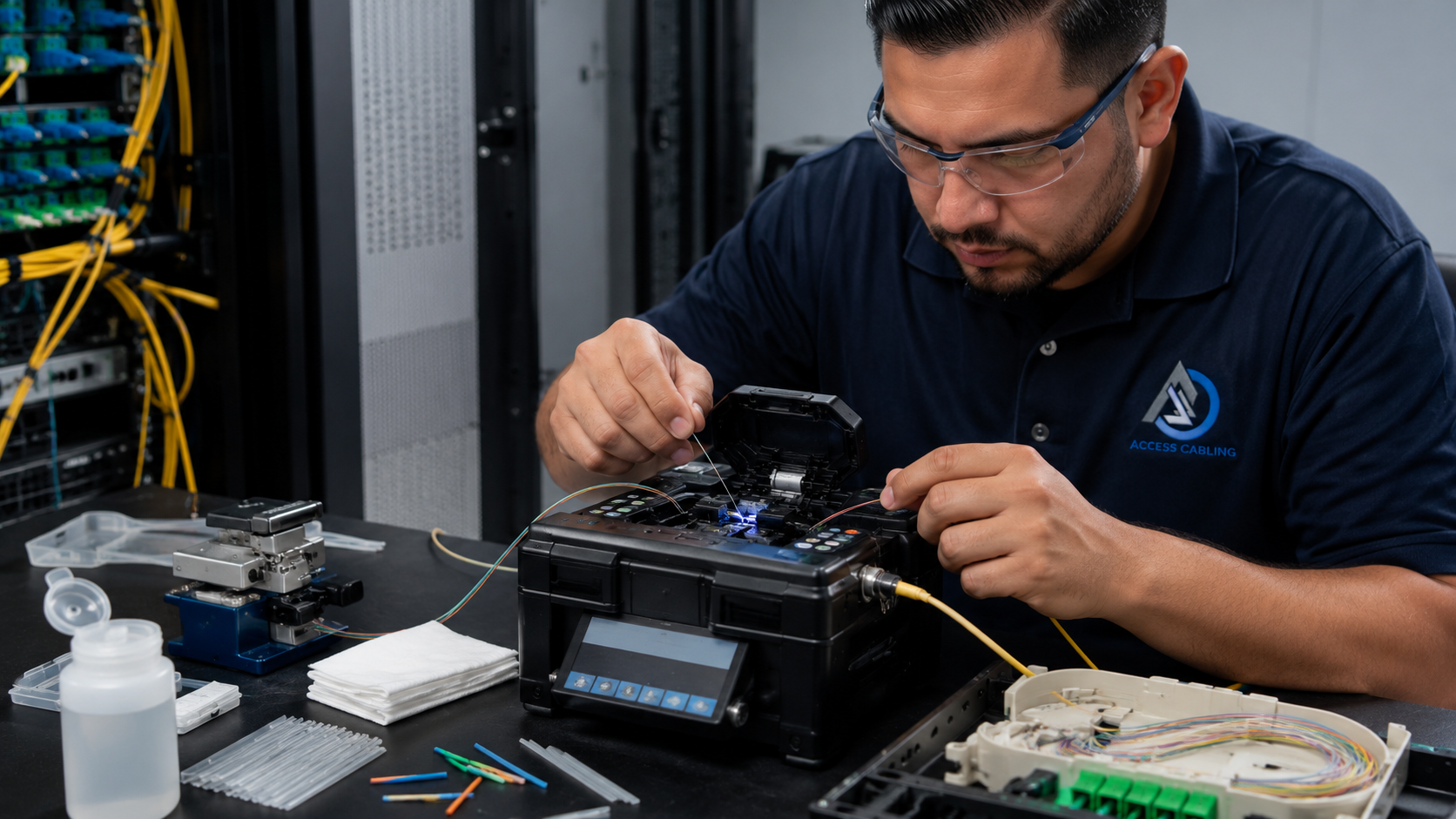
The installation of university cabling, especially OSP, demands meticulous planning and execution to minimize campus disruption while adhering to strict safety and quality protocols. Our installation methodology encompasses detailed pre-construction site evaluations, coordination with campus security, facilities, and academic departments, and obtaining all necessary permits (e.g., trenching, right-of-way). For OSP fiber runs, methods include directional boring to avoid obstacles and minimize surface disturbance, trenching and conduit placement (ensuring proper depth and burial markers per local code), and aerial installations that comply with NESC (National Electrical Safety Code) clearances. Fusion splicing is the preferred method for OSP fiber terminations and extensions, providing significantly lower loss and higher reliability than mechanical splices, crucial for long-haul campus backbones. All fiber terminations are performed in controlled environments, ensuring clean connections and minimal back reflection. Copper cabling installation (Cat6A) within buildings follows TIA-568-C guidelines for bend radius, pulling tension, and termination practices to avoid performance degradation. Cable pathways are carefully filled to comply with firestopping requirements (UL-listed firestopping materials) as per NEC articles 800 and 770. Comprehensive project management includes dedicated on-site supervisors, daily progress reporting, strict adherence to project timelines and budget, and continuous communication with university stakeholders. We emphasize a 'right the first time' approach, utilizing experienced technicians who are BICSI RCDD-certified and adhere to manufacturer-specific installation guidelines for optimal system performance and warranty validation.
Rigorous Testing, Certification, and Documentation Standards
Post-installation, comprehensive testing and certification are non-negotiable for university cabling infrastructure. For copper cabling (Cat6A), permanent link and channel certification is performed using Fluke DSX-8000 CableAnalyzers. This includes tests for wire map, length, propagation delay, delay skew, Near-End Crosstalk (NEXT), Power Sum NEXT (PSNEXT), Alien Crosstalk (ANEXT), Attenuation-to-Crosstalk Ratio Far-End (ACR-F), Power Sum ACR-F (PSACR-F), and Return Loss, ensuring full compliance with TIA-568.2-D performance specifications for 10GbE. For fiber optic cabling, testing is conducted using 광Power Meters (OPM) and Optical Loss Test Sets (OLTS) to measure insertion loss (light source and power meter method) and Optical Time Domain Reflectometers (OTDRs) for accurately locating splices, connectors, and breaks, as well as measuring overall link loss. All fiber testing adheres to TIA/EIA-526-14-B (for multi-mode) and TIA/EIA-526-7 (for single-mode). OTDR traces are provided for all fiber runs, documenting the attenuation characteristics and event losses along the entire cable length. Each test report is saved digitally, typically in a format compatible with Fluke LinkWare Live, and formally delivered to the university along with as-built drawings. The documentation package includes detailed floor plans with outlet locations, IDF/MDF rack elevations, fiber and copper backbone schematics, labeling schedules conforming to TIA-606-C, and manufacturer warranty information. This comprehensive due diligence ensures system integrity, facilitates future troubleshooting, and supports long-term network management, providing a clear audit trail of performance and compliance.
Scalability and Future-Proofing for Academic and Research Growth
University environments are dynamic, requiring cabling infrastructure that can seamlessly accommodate exponential growth in data traffic, emerging technologies, and expanding campus footprints. Our designs prioritize scalability and future-proofing, moving beyond current needs to anticipate 10-15 year horizons. This involves deploying high-strand-count OSP fiber (e.g., 96-strand or 144-strand OS2) even if immediate needs are lower, providing dark fiber capacity for future upgrades to 400GbE or even Terabit Ethernet without requiring new trenches. Within buildings, generous pathway sizing and conduit fill ratios (e.g., limiting fill to 40% for copper, 30% for fiber) ensure ample space for additional cable pulls without exceeding capacity or violating code. The systematic deployment of modular fiber optic distribution frames (FDFs) and copper patch panels allows for 'pay-as-you-grow' expansion, minimizing upfront costs while ensuring flexibility. We integrate solutions for high-density wireless LANs (WLANs), anticipating the requirements for Wi-Fi 6E and future Wi-Fi 7 standards, which demand multiple Category 6A drops to each access point location for multi-gigabit backhaul. Considerations for specialized research applications, such as high-performance computing (HPC) clusters or advanced telepresence systems, often involve dedicated fiber channels or even dark fiber extensions to research institutions. Our approach ensures that the university can adopt new educational technologies and research methodologies without costly and disruptive infrastructure overhauls, preserving operational continuity and investment.
Compliance, Safety, and Robust Environmental Considerations
Operating within a university setting mandates strict adherence to a broad spectrum of compliance and safety regulations. All installations are executed in full compliance with the National Electrical Code (NEC), specifically Articles 800 (Communications Circuits) and 770 (Optical Fiber Cables), which govern firestopping, grounding, bonding, and conductor protection. Fire-rated cabling (plenum-rated CMP, riser-rated CMR) is specified and installed according to building occupancy classifications and pathway routes. OSP installations scrupulously follow local and state dig laws (e.g., Call Before You Dig – 811) to prevent damage to existing underground utilities and ensure worker safety. Environmental considerations are paramount for OSP, including selecting UV-resistant jacketing for aerial cables, water-blocking gels or dry water-block designs for direct-buried fiber, and rodent-resistant armored cables in vulnerable areas. We assess environmental factors such as temperature fluctuations, humidity levels, and potential for corrosive elements in specific campus areas (e.g., chemical labs, athletic facilities) to specify appropriate industrial-grade components where necessary. All personnel are trained in OSHA safety standards, particularly concerning trenching, confined space entry, and working at heights. Our rigorous safety protocols and compliance record are a testament to our commitment to delivering not only high-performance networks but also projects executed with zero incidents and full legal and institutional adherence. This proactive approach minimizes risks for the university and ensures the long-term reliability and safety of the installed infrastructure.
Access Cabling’s Distinctive University Infrastructure Expertise
What truly differentiates Access Cabling in the university sector is our specialized, non-templated approach, rooted in decades of experience with complex, multi-building campus environments. Unlike generalist contractors, we understand the unique operational rhythms of academic institutions – the need to work around semester schedules, exam periods, and sensitive research activities. Our expertise extends beyond merely pulling cable; it encompasses value-added services like comprehensive infrastructure planning workshops with university IT departments, detailed budgetary forecasting for multi-phase projects, and providing engineering support for integrating new systems with existing legacy infrastructure. We are proficient in vendor-agnostic solutions, capable of deploying and certifying systems from leading manufacturers like Panduit, CommScope, Leviton, and Corning, ensuring the university receives the optimal solution rather than a constrained choice. Our C-10/C-7 licensing and CSLB 992009 registration underscore our qualifications for both inside and outside plant low-voltage work, providing a single point of responsibility for the entire campus infrastructure. We provide custom maintenance and support agreements post-installation, including emergency fiber restoration services, which are critical for maintaining continuity in a 24/7 academic environment. Our focus is on strategic partnership, offering long-term reliability, scalability, and an infrastructure that actively supports the university's mission of education and research without compromise.
Integrating AV and Security Networks with Core IT Infrastructure
Modern university campuses rely on a complex interplay of networks beyond traditional data and voice, specifically integrating Audio/Video (AV) distribution systems and comprehensive physical security networks. These specialized networks demand meticulous planning during the cabling infrastructure design phase to avoid interoperability conflicts and ensure optimal performance. For AV systems, this often involves the strategic deployment of HDBaseT or SDVoE compliant cabling, frequently utilizing shielded Cat6A or fiber optic runs, to support high-bandwidth 4K/8K video transmission alongside control and power over a single cable. Careful consideration must be given to signal latency, electromagnetic interference (EMI) in lecture halls or studios, and sufficient power delivery via Power over Ethernet (PoE++) for devices like projectors, interactive displays, and distributed audio systems. For physical security, which encompasses IP surveillance cameras, access control systems, and emergency communication endpoints, the cabling infrastructure must support substantial power requirements, ensure network segmentation for security protocols, and provide robust environmental protection for outdoor deployments. This involves specifying industrial-grade Cat6A/7 cables with enhanced UV resistance and water-blocking gels, alongside hardened fiber optic cables for extended outdoor runs to remote campus buildings or perimeter monitoring points. Furthermore, dedicated pathways and redundant network topologies are often mandated for security systems to maintain operational continuity during outages, adhering to standards such as NFPA 72 and UL 2050 for fire alarm and security system installations. The convergence of these diverse systems onto a unified, yet logically segmented, IP backbone requires a deep understanding of bandwidth aggregation, Quality of Service (QoS) prioritization for time-sensitive traffic, and robust cybersecurity postures applied at the physical layer to prevent unauthorized access or denial-of-service attacks on critical campus infrastructure.
Optimizing Wireless Deployment Through Intentional Cabling Backbones
The pervasive demand for ubiquitous wireless connectivity across university campuses necessitates a meticulously designed cabling backbone that anticipates and supports current and future Wi-Fi standards. Transitioning from Wi-Fi 5 (802.11ac) to Wi-Fi 6/6E (802.11ax) and beyond requires a robust infrastructure capable of delivering multi-gigabit speeds to Access Points (APs). This typically involves deploying a minimum of two Cat6A or single-mode fiber optic drops to each prospective AP location to accommodate aggregated throughput and provide redundancy, especially in high-density areas like lecture halls, libraries, and dormitories. The cabling pathways must be engineered to prevent capacity bottlenecks and ensure adequate ventilation to dissipate heat generated by high-power APs and associated PoE switches. Strategic placement of APs, informed by detailed predictive heat mapping conducted with tools like Ekahau or iBwave, directly influences the required cabling density and length, impacting signal coverage and interference mitigation. Furthermore, the increasing adoption of IoT devices, from smart building sensors to environmental monitors, adds further demands on the wireless network, necessitating a cabling infrastructure that can scale to support a vast number of concurrent connections and potentially higher PoE requirements. Proper cable management, including segregation from high-voltage lines, and precise labeling are critical for rapid troubleshooting and future upgrades. Ignoring these foundational cabling requirements results in suboptimal wireless performance, costly retrofits, and a diminished user experience, directly impacting academic activities and student satisfaction. The initial investment in a well-planned, high-capacity wired backbone for wireless is demonstrably more cost-effective than continuous short-term fixes or complete infrastructural overhauls every few years, embodying a long-term total cost of ownership (TCO) efficiency standard.
Regulatory Compliance and Campus-Specific Code Adherence
University cabling projects operate within a stringent framework of regulatory compliance, extending beyond industry-standard TIA/EIA guidelines to include campus-specific codes, state mandates, and federal regulations. This necessitates a detailed understanding of the National Electrical Code (NEC) articles, particularly Articles 770 (Optical Fiber Cables), 800 (Communications Circuits), and 820 (Community Antenna Television and Radio Distribution Systems), ensuring all installations meet fire safety, grounding, and bonding requirements. Furthermore, campus-specific building codes, often more restrictive than state minimums, dictate pathway fill ratios, conduit specifications (e.g., minimum 1-inch conduit for each Cat6A drop to prevent kinking), plenum vs. riser cable selection based on air handling systems, and seismic bracing requirements in certain geographical zones. Adherence to ADA (Americans with Disabilities Act) guidelines is critical for accessible pathways and device placement. Environmental regulations concerning hazardous materials (RoHS compliance for equipment), waste disposal, and sustainable construction practices (e.g., LEED certification requirements for new buildings) must also be integrated into project planning and material selection. For research institutions handling sensitive data, compliance with HIPAA, FERPA, and various cybersecurity frameworks (e.g., NIST, ISO 27001) extends to the physical layer, mandating secure pathways, access controls for telecom closets, and robust data center cabling practices. Failure to comply can result in severe penalties, project delays, safety hazards, and significant reputational damage. Our methodology integrates a pre-emptive regulatory review, collaborating closely with university facility management, IT governance, and environmental health and safety departments to ensure all design and installation specifications are fully aligned with applicable codes and standards from project inception to final commissioning.
Fiber Optic Infrastructure for Research and High-Performance Computing
Advanced research facilities and High-Performance Computing (HPC) clusters within universities demand a fiber optic infrastructure that transcends standard enterprise deployments, characterized by significantly higher port densities, lower latency requirements, and massive aggregate bandwidth capabilities. This necessitates the strategic implementation of Dense Wavelength Division Multiplexing (DWDM) or Coarse Wavelength Division Multiplexing (CWDM) technologies over single-mode fiber (OS2) to maximize fiber utilization and support multi-terabit network backbones connecting data centers, specialized labs, and supercomputing resources. Deployment often involves 288-count or 432-count loose tube or ribbon fiber optic cables for main distribution, utilizing MPO/MTP connectors for rapid deployment and high-density patching in telecom rooms and data halls. Specialized fusion splicing techniques, such as mass fusion for ribbon fiber, are employed to minimize splice loss and accelerate deployment, followed by rigorous Optical Time Domain Reflectometer (OTDR) testing at 1310nm, 1550nm, and sometimes 1625nm wavelengths to certify link budget integrity. Furthermore, specific research applications, such as large-scale data acquisition from particle accelerators or high-resolution imaging in biomedical sciences, may require dedicated, diverse dark fiber paths to meet extremely low latency and deterministic bandwidth requirements, often necessitating direct burial or aerial infrastructure for campus-wide reach to remote observatories or testing sites. The physical security and environmental protection of these critical fiber pathways, including robust conduit systems, rodent-resistant armor, and redundant routing strategies, are paramount to ensuring uninterrupted access to vital research data and computational resources. This deep dive into high-performance fiber optics differentiates university cabling from commercial projects, demanding specialized engineering expertise in optical network design, deployment, and ongoing maintenance to support cutting-edge academic and scientific endeavors.